
Do you know what all shopping malls have in common? They all want to increase sales.
So countless strategies are developed to increase customer flow: they promote events, paid media, partnerships, promotions, traditional advertising, etc.
But there's a trick that can be used to attract more consumers, one that every shopping mall has, but that most of them haven't realized yet: using the online reputation of the retailers themselves to rank better in online searches.
Keep reading to learn more.
At what exact moment are consumers most receptive to brand messages?
Did you know that almost a third of all searches made on mobile devices are location-related? The user wants to know which establishment is closest to them.
When a consumer goes to the mall, they are usually looking for a specific product or service. Making sure they find a store in your mall during their online search is what will increase customer traffic to your shopping center.
Your challenge is to ensure your shopping mall is found at the moment of the search process—the exact moment when consumers are most receptive to brand messages.
What are micro-moments in the consumer buying journey?
Micro-moments occur when people search the internet to satisfy a specific desire to know, do, go , or buy something. These are instants of genuine purchase intent where decisions are made and preferences are shaped in a matter of minutes or seconds.
This is a concept presented by Google, and you can learn more about it here.
The cell phone is by far the most used device in these micro-moments, because most of the time it is the device closest to the consumer at that instant when a new need arises.
To give you an idea, users smartphone look for information on their devices while multitasking, whether it's chatting with friends, answering emails, or even cooking—and it's during these pauses for online research that your golden opportunity arises—it's at this moment that your shopping mall should appear as the best solution for their search.
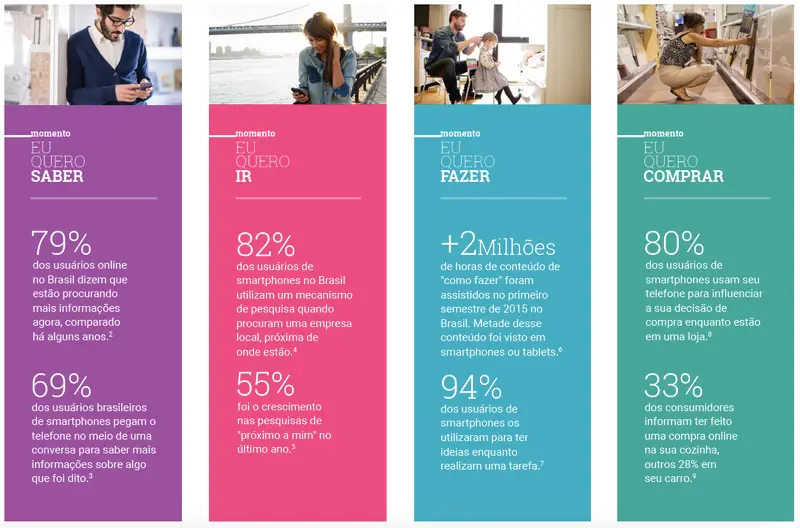
Discover the 4 micro-moments defined by Google:
| Moment: I want to know | Satisfying our curiosity. Before, we had to wait to look for information; now, we can have it at our fingertips at any time. 65% of smartphone users use them to learn more about something they saw on TV. |
| Moment: I want to GO | Getting where we want to go.The sophisticated location tools available on smartphones are helping consumers find what they want and get them where they want to go. Searches for 'near me' grew 55% between January and June of 2014 and 2015. |
| Moment: I want to DO | Doing what we want.Consumers no longer need to wait to find out how to do something. It's possible to search the moment the need arises, such as how to fix a car, create a hairstyle for a party, or make a recipe in the kitchen. Searches related to 'how to' on YouTube grew 72% between January and June 2015 in the United States, according to YT Analytics, based on the 270 'how to do' videos with the highest watch time. |
| Moment: I want to BUY | Deciding on purchases at every stage of the journey.Whether it's replacing something broken, buying a new product, or simply gathering information about something you intend to buy, these moments are happening more frequently. 79% of Brazilian consumers say they are making purchasing decisions faster now than they were a few years ago, thanks to online research. |
How to increase your shopping mall's sales by leveraging micro-moments
You can increase your chances with micro-moments by investing in local SEO.
Remember that more than a third of mobile searches are location-based? It makes perfect sense to improve your shopping mall's relevance to rank better in local searches.
Local SEO is a set of actions aimed at increasing the likelihood that your business will be found by a user performing a local search. It's a way to attract more local customers to your establishment—customers who are nearby, looking for what you have to offer.
In other words, investing in Local SEO means optimizing your online presence so that search engines (like Google My Business) position your establishment in the top results when a user performs a local search.
Check out this post : Local SEO: what it is and how to increase the chances of your business being found by local consumers.
How can shopping malls effectively leverage local SEO?
1. NET Data (Name, Address, and Phone Number)
The biggest enemy of companies in local ranking is incompatible NET data.
According to research by MOZ, NET data is part of on-page SEO (keywords, domain authority, etc.), which accounts for 26% of search results.
You need to ensure that all your merchants have all this data complete and up-to-date.
Ensure that retailers:
- Those who have websites should include the business address in the website footer. This should be in text format, not an image.
- Updated and properly completed NET data on all online profiles where the establishment is registered (Facebook, Google My Business, TripAdvisor, iFood, etc.).
- Please note that you should not include "Av Dantas Barreto near the Shell gas station" in the address. This is not a valid address. Only include the street/avenue name plus the number – "Av Dantas Barreto, 1587". Invalid addresses are the second most damaging factor in business ranking.
- The business name must be identical across all online profiles. It cannot be "Zé's Pet Shop" on Facebook and "Zé's Pet Shop" on Google My Business. This greatly hinders the business from achieving top search engine rankings.
2. Business Category
According to the same research done by MOZ, incorrect business category in GMN (plus invalid address) is in 2nd place on a list of negative factors that harm the ranking of local businesses.
It is essential that retailers mark the correct category for their business. Note: in Google's words, "business category describes what your business is, not what it offers.".
Many businesses miss opportunities because they're in the wrong category, so pay attention. Tip: Don't use categories solely as keywords or to describe some attribute of your business. Choose the one that best represents your main activity.
3. Establishment description text
Be as brief and objective as possible and talk about what your company offers, what differentiates it from the competition, its history, or other information useful to customers.
Please note: the description is not the place for information about promotions, prices, or sales.
Ideally, focus only on what makes the establishment unique. Also, reinforce to your tenants the importance of uploading high-quality, up-to-date images or videos of the products, services, and facilities of the business.
Here's an example of an effective description:
"Our artisanal ice cream shop is located just a few meters from the city center and receives a large flow of people who meet friends for ice cream or pizza . We deliver . We have 35 flavors of homemade ice cream and sorbets served by hand all year round. We also serve a delicious thin-crust pizza with a crispy edge every day starting at noon . We're waiting for you!"
4. Online reviews – a powerful attribute for increasing customer traffic, but one that is still ignored by most shopping malls
Online reviews have a significant impact on SEO and search results. Although all shopping malls have online reviews, few have realized this powerful tool for increasing sales.
According to data from MOZ, online reviews influence 6.5% of a local search ranking. And when we talk about Google's local pack, the influence is even greater: it impacts an incredible 15.5% of search results.
Local pack is the results box that appears when you perform a local search. In it, Google shows 3 suggestions of establishments that best match the user's search, and offers a "see more" button that, when clicked, displays a list of all nearby places ranked according to their online reputation.
The purchasing process has changed, and it hasn't been a recent development. Today's consumer is much more informed and demanding.
Online reviews play a key role in purchasing decisions, since traditional advertising no longer works as it once did, and consumers place much more trust in the words of other customers than in those of the brand.
The shopping mall that manages to implement a review culture among its retailers will gain a significant advantage over its competitors, since most of them have not yet realized the potential of reviews to increase sales.
Want to learn more about the benefits of managing online reviews and how it can help your business grow? Watch this webinar: What is the feedback economy and how does it affect my business reputation?
Did you enjoy the content? Share it on your favorite social network and spread the knowledge to your friends!