
The Local Search Ranking Factors 2026 report by Whitespark—the most respected study on local SEO in the world— has just been published
Every year, Darren Shaw, CEO of Whitespark, brings together the world's leading experts—this year there were 47 professionals—to answer a crucial question for brick-and-mortar retail:
What really makes a store appear in the top positions of Google's local search results and attract more customers to it?
Extremely rich in detail, this year's report provided clear evidence of a significant shift in the local search algorithm: reputation, engagement, consistency, and—most importantly—customer experience have increased in weight among the factors considered.
This changes how Google views the physical world from a digital perspective to decide which stores deserve to appear at the exact moment the consumer is ready to buy.
In this article, I interpret the main results of the report from the perspective of Brazilian retail, also incorporating insights and patterns observed by Harmo, which daily collects and processes data from more than 50,000 stores across the country—a volume that allows us to identify real trends in customer behavior and how this translates into reputation and traffic. My goal is to make the report applicable and show why this topic needs to be firmly integrated into companies' marketing planning.
There's a lot of money being left on the table.
Fact: Google now prioritizes human signals, not just technical signals.
One of the most important (and surprising) conclusions of the study is the paradigm shift revealed by the algorithm's behavior.
The more technical factors remain important, but they have lost prominence to something simpler and more powerful:
Everything that connects to the real experience the customer has in the store.
In the report, two groups grew more than all the others in Local Pack/Maps:
- Review Signals (recency, frequency, sentiment, volume, speed, depth)
- Behavioral Signals (routes traced, clicks, calls, post-click engagement)
In other words: Google is evaluating stores as if it were a consumer.
Recent reviews, regular feedback reception, profile engagement, photos submitted by customers themselves, actions taken through Google Maps, responses to reviews, and constant updates to the Google Business Profile (GBP) — all of this has become more important than it was last year.
Google evaluates not only what your store is, but how it works. And most importantly: what customers say about their experience.
The message is clear: Experience has become an acquisition.
Brazilian consumers are amplifying this change.
The Whitespark report is global, but the Brazilian market makes everything more intense. In the Local Decision 2025, by Harmo + Reclame AQUI, we saw that:
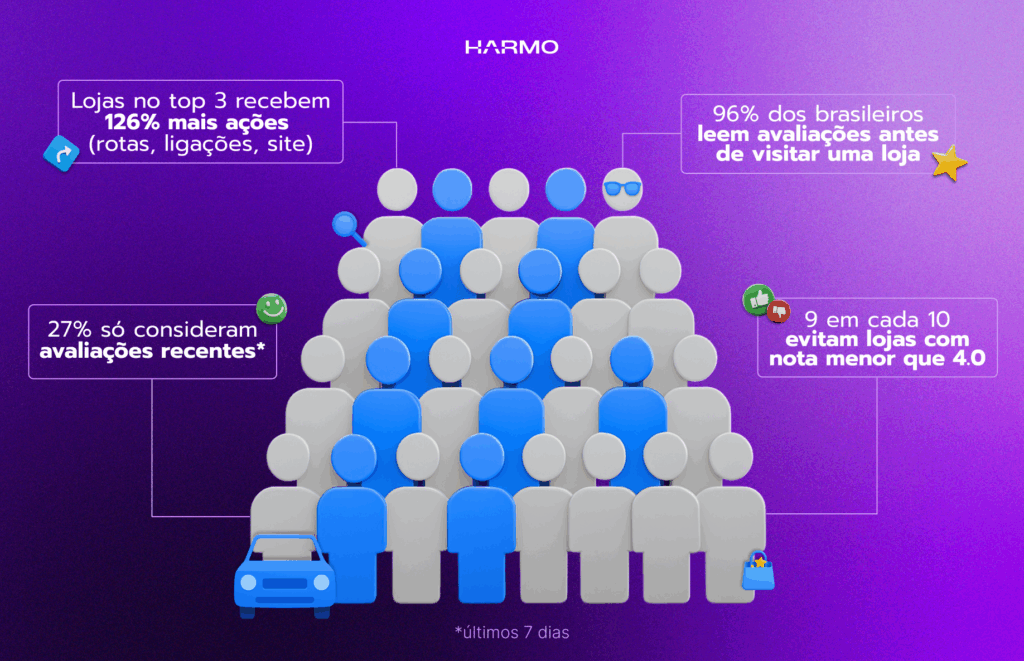
Brazil is arguably one of the most reputation-sensitive countries in the world. Here, the factors highlighted by Whitespark are not trends, they are the daily reality of retail.
The dynamic is simple and unforgiving:
- When the number of positive reviews increases, the rating goes up.
- When the grade goes up, the reputation improves.
- When reputation improves, trust grows.
- When trust grows, the flow increases.
It's a cause-and-effect cycle driven by customer recommendations.
The 4 major trends revealed by the Whitespark report.
After thoroughly analyzing the material, four structural movements become clear:
1. Digital reputation has become the heart of the algorithm.
For Google, user reviews are the most reliable reflection of real-world experience.
In the study, Review Signals rose to a new level and became key players in both the Local Pack and AI Search Visibility. Reviews should be treated as a marketing strategy , not just a customer service function.
2. Engagement has become synonymous with relevance.
The Behavioral Signals group also gained importance. Google gives preference to profiles that demonstrate activity:
- recent posts
- new photos
- updated information
- responses to evaluations
- actions generated by the profile
Abandoned profiles lose ground, and for retail this is critical: many networks still treat GBP (Good Business Profile) as a registration process and not as an acquisition channel.
3. The website has once again become a key element.
In the study, factors related to the website rise sharply:
- Dedicated Page for Each Service (#1 in Local Organic and #2 in AI Visibility)
- local content
- Consistent NAP
- schema
- geographical relevance
- title, headings and semantic structure
For Brazil, the warning is even more urgent: The vast majority of retail chains still operate a generic "our stores" page. And worse: when the customer clicks on "directions," they are sent to an empty geolocation pageinstead of the store's GBP profile, which contains reviews, photos, hours, features, and everything that truly converts customers. A basic error that I still see happening every day.
4. AI and social signals are definitely entering the game.
Whitespark has added an AI Search Visibility, and the results are revealing. Factors such as:
- content authority
- coherence across multiple sources
- unstructured quotations (newspapers, blogs, government, associations)
- reputation with third parties
- presence on "best of" lists
- local social activity
They gained traction as signs of authority. AI does not recommend brands that are inconsistent or disconnected from the local context.
What changes in practice for those who depend on Google My Business (Google Business Profile): Interpreting the main factors of the 2026 ranking.
Below are the pillars that most influence your position in Local Pack, Local Organic , and AI Search Visibility.
1. Google Business Profile (ex-GMB)
GBP remains the central factor. In Local Pack/Maps, 8 out of the top 10 factors come directly from GBP. These include:
- primary category
- additional categories
- Always up-to-date hours (Business is Open at Time of Search — #5 in the ranking)
- recent photos
- constant posts
- description with well-structured semantics
- attributes filled
- services and products
- quick answers
If the information is bad, the ranking will be bad. It's that simple.
2. Reviews: the most powerful factor
Evaluations have a direct impact on:
- reputation
- conversion
- ranking
- behavior
- trust
- perception of quality
- physical flow
Google analyzes:
- Recency (Review Recency)
- Frequency (Review Velocity)
- sentiment (Sentiment Analysis)
- text
- customer photos
- depth
- response speed
- recurring themes
Not encouraging reviews means giving up on new sales.
3. Behavioral engagement
Google values:
- planned routes
- clicks on the website
- connections
- messages
- Post-click engagement (Dwell Time)
- interactions with the listing
These signals show whether the result was good, and the algorithm promotes those who generate positive engagement.
4. Well-constructed Local Landing Pages (LLPs)
Site factors have gained prominence in both organic search and AI search. A complete LLP should include:
- name, address, phone number (NAP identical to GBP)
- updated schedule
- real photos
- recent reviews
- GBP posts
- route buttons, phone, WhatsApp
- menu/catalog when applicable
- Integration with Google Maps
- contextualized local content
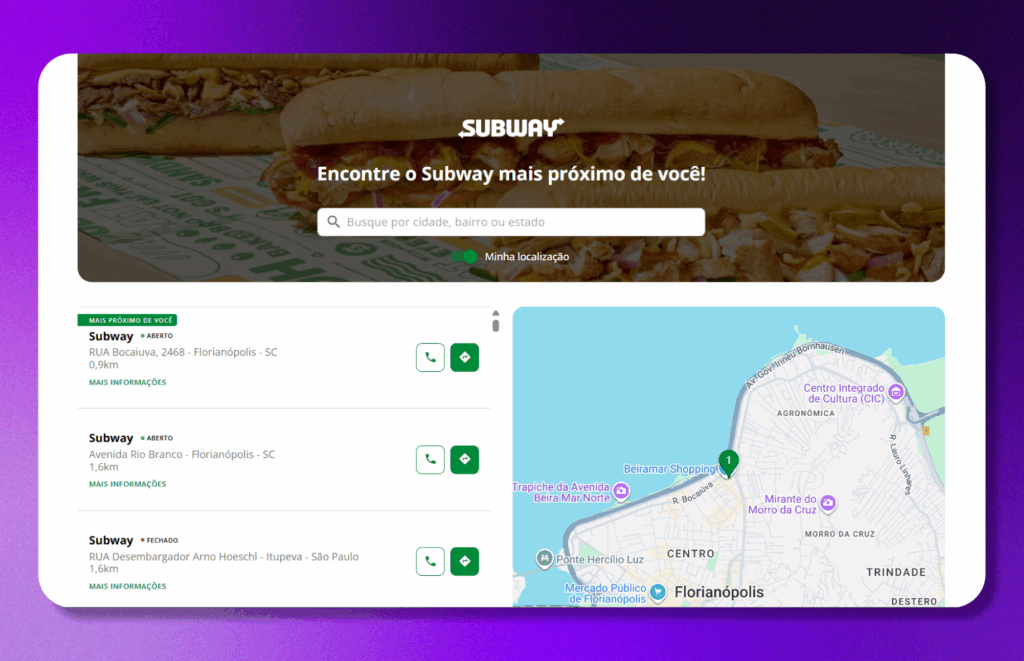
LLPs created by the Harmo platform and automatically updated from GBP – Click here to access the Subway one.

LLPs created by the Harmo platform and automatically updated from GBP – Click here to access Bullguer's.
A well-executed LLP reinforces all other signals.
5. Consistency (NAP) – where less is more
The study makes it clear: inconsistent citations harm ranking. But here's an important nuance from our reality. Abroad, citations are back! — especially in AI Search Visibility, where 3 out of the 5 main factors are citations/mentions.
But that does NOT mean registering your brand in 50 irrelevant directories, because Brazil is not the USA – there are hundreds of super relevant and segmented directories there, which doesn't happen here. Here there is 1 truly relevant directory and it's called: Google Business Profile.
Don't fall into the temptation of being present in directories like Yelp, Foursquare, Guia Mais, or Apontador. Have you ever seen anyone using these channels? So why put your store network on them? If you don't keep your information constantly updated, it will generate inconsistency.
Excess = outdated = inconsistent = drop in ranking
The best practice is:
- Focus on the channels that really matter.
- keep everything always updated
- Ensure consistency between GBP, website, and relevant platforms.
For restaurants: Google, iFood, TripAdvisor. For everyone else: Google, Apple Maps, Meta, official website. Remember, in local SEO, less is more.
6. Authority and cross-platform consistency
AI and traditional algorithms penalize inconsistency. If GBP says one thing, the website says another, and the reviews tell yet another story, Google loses confidence and downgrades the store. Consistency has become a competitive factor.
7. Social signals as reputation reinforcement
Social signals have made a strong comeback in the matrix of factors. Local engagement, participation in events, and an active presence on social networks have become ways to reinforce reputation and popularity—and this directly influences where your store appears.
The 5 most common retail mistakes
- Treat reputation as a problem, not as an asset.
- Treat reviews as a form of customer service, not as a conversion.
- Abandoning the GBP or treating it as a mere "yellow list"
- Maintaining a generic website that is disconnected from the physical store.
- Separating Marketing, Customer Service, CRM, and Operations, when the algorithm centralizes everything.
What should really be prioritized?
1. Daily evaluation goals
If the store is open every day, it should receive reviews every day.
2. Respond to reviews quickly and strategically.
Answer for the person who will read it — not for the person who wrote it.
3. Continuously update and move the GBP.
Posts, photos, descriptions, attributes, schedules, services.
4. Ensure absolute consistency of information.
Has it changed in GBP? It changes in all relevant channels.
5. Create complete and up-to-date LLPs.
Connect GBP to the website. Make LLP the official store page.
The inevitable cycle
Better experience → more and better reviews → better ranking → more routes → more visits → more sales.
Google recommends those who provide the best service; the reviews reflect real-world experience, and the algorithm uses this experience as a ranking criterion. The competition is no longer just technical, because the human factor has entered the center of the game; after all, consumers trust other consumers, and Google is amplifying this conversation.