
In this article, I present my conclusions on the main sources of influence in consumers' purchasing decisions, so that we can exchange ideas about the role of advertising in the era of customer experience, since it is still responsible for more than 70% of all companies' advertising budgets.
To write this article, I invited my friend Jailson de Sá, one of the most experienced marketing and communication professionals in Brazil, owner of the Acontecendo Aqui portal, a market leader when it comes to advertising, marketing, communication, and innovation.
I am passionate about advertising, so much so that I started my professional career working in agencies and have always worked in the field, until I ventured into entrepreneurship with Harmo.
Advertising has an incredible power to capture our attention and awaken almost unconscious desires to connect with brands.
We, as consumers, see ourselves in brands and, therefore, want to buy and use the products they represent.
Who hasn't been moved by a commercial? How many campaigns have marked our lives and remained forever in our memories?
When it comes to building a brand's image and the values it represents, advertising is undoubtedly the best way to achieve that goal. And we all know that a brand is something extremely valuable and takes years and years to build.
But as society evolved, traditional advertising, which once held great influence over purchasing decisions for products and services, saw its influence diminish.
But that doesn't mean, in my opinion, that it's no longer relevant. Quite the contrary. The point now is to understand what role advertising plays in the new scenario we live in.
The role of advertising in the new scenario we are experiencing
A recent study by the Qualibest Institute revealed the main sources of influence when buying a product. Below are the final results of the study.
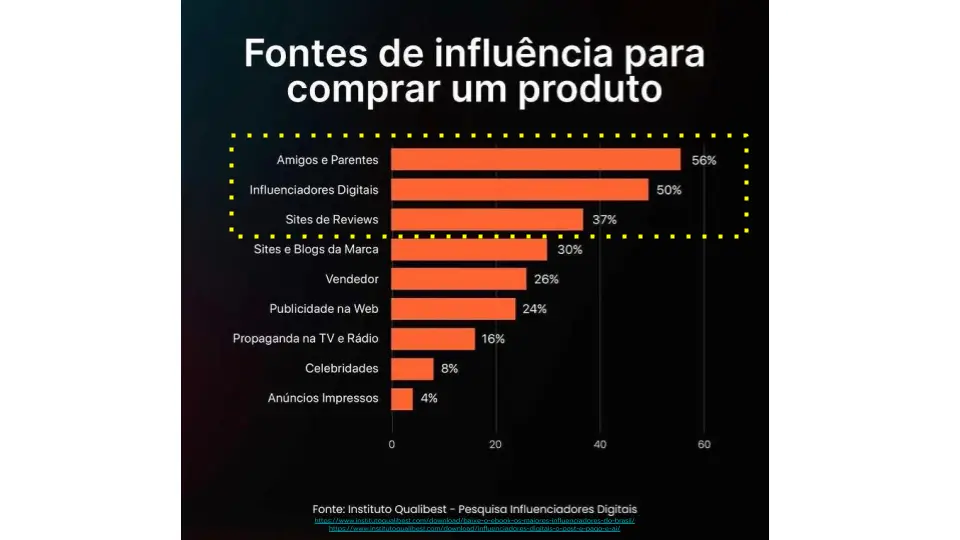
Friends and relatives, the traditional word-of-mouth among acquaintances, continues (and will always continue) to be the main source of influence.
Next come the "digital influencers," who are currently divided into several levels and categories and are gaining increasing importance and space in the marketing plans of companies of all sizes, precisely because they generate value for the brands they associate with, whether by attracting qualified leads (potential customers) or by directly converting sales.
And in third place are the reviews, the famous public customer ratingsshared about products and services, usually on a scale of 1 to 5 stars, on sites like Google, Trip Advisor, Facebook, Yelp and apps like iFood, Uber, Rappi, among others.
This type of evaluation quickly became popular because it is easy to interpret and answers the consumer's question about the reliability of what they are about to buy.
Tip: Why are Google reviews important for your business?
Personally, I consider reviews to be like a kind of long tail for digital influencers.
If we think about it, nowadays we are all digital influencers.
Every review a customer writes publicly online about a product, service, store, restaurant, etc., contributes to influencing the decisions of potential customers.
Therefore, among the top sources of influence for purchasing products and services, we have three strategies directly related to good old-fashioned word-of-mouth advertising. That's a fact.
But it wasn't always like this. Let's go back a century to understand how communication and advertising have evolved to this day.
The evolution of communication and advertising
During the first half of the 20th century, cinema became a form of family recreation. The first films were made in the late 1800s and early 1900s. Later, in 1920, came home radio and, 20 years later, home television.
The first official radio station began operations on November 2, 1920, in Pittsburgh, Pennsylvania. By the mid-century, radio began to expand across the United States as additional sets were installed in automobiles. There was a multiple penetration in different forms of radio.
In the early 1960s, television also began to expand. By the 1970s, television was practically everywhere in the world. Later, new media such as cable TV and videocassette recorders were added.
With the advent of mass media, mass advertising emerged. That is, large advertising campaigns with a single message, created by a company, talking about itself (the brand) to the general public, with the aim of arousing desire and persuading them to buy the product or service.
Advertising campaigns broadcast on mass media (radio, TV, newspapers, magazines, and cinema) reached millions of consumers, with little distinction beyond some basic characteristics such as social class and age, depending on the type of advertising space where they were broadcast.
Their great advantage was their ability to reach an entire population quickly and with the same information. It was a gigantic cannon shot that, in the end, hit a few thousand consumers. But mass media has always had a major challenge: measuring results.
The challenge of mass media today
Up until the 1980s, this was reasonably possible to calculate. Because at that time, only mass media existed to spread advertising messages. The internet did not yet exist.
So when we only have one way to receive the message, it becomes easy to determine where an increase in customer flow is coming from.
If, after the commercial airs during prime time, the stores are packed the next day, we know it's because of the campaign. Anyone who's a fan of the series Mad Men, like me, knows exactly what I'm talking about.
Back then, word of mouth was also quite limited, because we, as consumers, didn't have the means to recommend products and services en masse, as we do today.
Another key point is that, before the internet existed, the power to express our dissatisfaction with our experiences with brands was completely limited to the customer service departments of the companies that owned those brands.
In other words, it was practically nonexistent. We had no power over the reputation of the brands.
We can conclude that, in the past, traditional advertising, due to mass media being essentially the only form of communication distribution, had a wide reach and influence, while word-of-mouth had a low reach and influence on the decision-making power regarding the purchase of products and services.
But things are very different today.
Mass media versus experiential marketing
Now we, as consumers, have enormous power over brands, and what allowed this reversal was undoubtedly the internet. And this power shift is visibly transforming marketing.
In today's digital age, where we are all connected and sharing our experiences with brands, marketing has begun to view the customer in a new light. Now, the customer, not the brand, holds the greatest power in influencing the purchase decision process.
Tip: The new experiential marketing: total focus on the customer.
For this reason, communication increasingly needs to be based on sincere purposes that are connected to the brand's DNA.
This movement ranges from the public behavior of its shareholders and top executives to its engagement in social impact initiatives.
One of the main consequences of this power reversal is that the customer has now become one of the primary channels for acquiring new customers. The customer is now a decisive influencer in the final stage of the sales funnel.
The customer as a channel for acquiring new customers
Marketing professionals, on the other hand, whose mission is to create consumer experiences, are increasingly challenged to break through the behavioral bubbles created by algorithms, which only release content based on each person's online content consumption.
The influencers' power would be limited to these behavioral bubbles created as a result of this content targeting based on browsing preferences.
In this new scenario, brands need to create and implement strategies that focus on constantly increasing new customer reviews, publicly recommending their products and services.
Brands also need to pay close attention to negative reviews, providing immediate and appropriate feedback to these customers in a public manner, to regain the trust not only of the customer who complained, but also of the thousands of potential customers who will read the company's response.
Marketing now needs to focus its attention on customer experience. Customer experience is definitely the new marketing.
Positive experiences throughout the journey generate positive reviews, which contribute to attracting more customers.
Not to mention the huge additional gains related to improving the experience, such as lower CAC and the customer's willingness to pay a higher price for the product/service offered.
And there's more. There's a Search Engine Optimization (SEO) issue that's intrinsically connected to the issue of reviews.
Search engines prioritize businesses and products with a higher number of positive reviews in their results. Search engine algorithms also increase the relevance of companies that respond to customer reviews.
In other words, the more your company is publicly recommended online, the better ranked it will appear, precisely when consumers are conducting searches with purchase intent (bottom of the funnel). Fact.
Therefore, we can conclude that, currently, online word-of-mouth has a gigantic reach and a powerful influence on consumers' purchasing decisions, while traditional advertising, as proven by research from the Qualibest Institute, despite still having a large reach, has lost influence.
The purchasing process has changed
Now we, as consumers, buy what we want, when we want, where we want, and we make our decisions based on shared reviews from other consumers who have already bought and used what we are researching, whether it's a product or service.
When it comes to the bottom of the funnel, reviews and digital influencers are far more decisive than advertising, as research by Qualibest has proven.
But again, this doesn't mean that advertising has ceased to be important, quite the contrary.
We understand that, in reality, advertising now, more than ever, needs to be used as "THE" tool for brand building, awareness, and creating emotional bonds.
So, why do internet giants advertise on television? You've probably already been reached on television by advertisements from Google, Amazon, Apple, Facebook, Microsoft, Netflix, Uber, Mercado Libre, and many others.
Television offers a greater return on investment in media compared to the internet itself, in the long term. There is no comparison with TV when it comes to brand reach. TV and other mass advertising media are capable of building a future audience for the brand.
We often read that over 80% of tweets about content refer to television. When we read that people consume information through two or more screens, one of them is almost always the television.
TV commercials convey emotion, empathy, and engagement with the brand and the characters used in the advertising.
These are people seeking leisure or broader information and are willing to watch 30- or 60-second commercials, unlike consumers of content on social media where message times are much shorter, 6 seconds, given the speed imposed by the platforms used by this audience.
Therefore, what is recommended are cross-media actions designed according to the strategy of each product or service.
However, I have the impression, and I may be wrong, that there is still a very ingrained belief that advertising campaigns broadcast in mass media need to be responsible for increasing sales and customer traffic in stores.
In my humble opinion, expecting that from traditional advertising today is using it for the wrong purpose.
Where does traditional advertising fit into a customer acquisition strategy?
It's practically impossible to measure the results of traditional advertising, broadcast on mass media, and it's expensive, very expensive. For me, this is a strong argument for using mass advertising for brand building and not for increasing sales, especially in the short term.
There are far more effective, measurable, and cost-effective strategies for increasing sales and generating more customer traffic in stores, whether physical or online, than mass media.
On the other hand, brands are beginning to see "customer experience" as an actionable strategy, whose main objective is related to customer acquisition.
And when we talk about "customer experience," it's crucial to include in the tactical plan the final action, the one that will attract new customers to the company: asking your customers to positively and publicly recommend your brand online.
The new experiential marketing
In short, the formula for the new experiential marketing works in the following sequence:
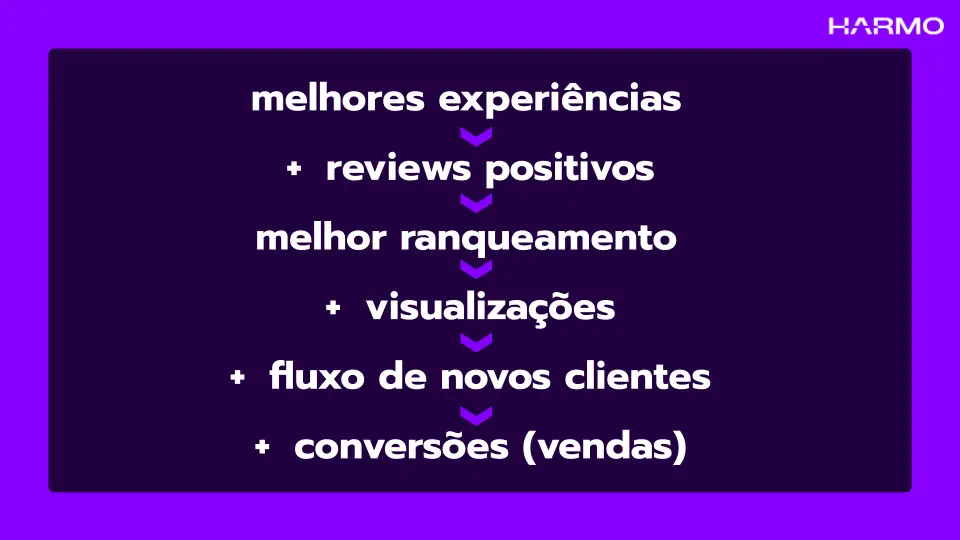
Considering that:
- Advertising no longer has as much influence on consumers when it comes to buying a product.
- Influencer recommendations and customer reviews greatly influence consumers when buying a product.
- The best advertising is done by satisfied customers (online word of mouth), using new technologies that allow us to share our experiences with brands.
I leave you with this thought-provoking question: in the age of customer experience, how do you view the role of traditional advertising? Do you believe it still effectively functions as a customer acquisition strategy?
⭐Extra Content:
Watch our webinar on experiential marketing. In the Experience Era, consumers choose products and services based on experiences shared publicly in the form of reviews on Google or TripAdvisor, or Facebook Recommendations. If your customer is choosing to do business based on the experience they receive, that's where you should focus your efforts and investments. Check out everything you need to know in this webinar!