
Online reviews are essential for businesses, and through customer opinions, any establishment can be digitally evaluated and classified as good, average, or bad.
Of course, it's not just about receiving reviews and listening to customer opinions; you also need to respond to the people who took the time to give their feedback on your brand, whether those reviews are positive or negative.
45% of consumers are more likely to choose businesses that respond to their customers (review trackers), and having a defined strategy for responding is essential. With that in mind, we've created a guide to help you better evaluate the feedback your customers provide. Follow along and benefit from this strategy!
Why is it important for your company to respond to online reviews?
Reviews are social proof of your business's credibility, and good response management can guarantee increased credibility, a stronger connection with your audience, and even generate buzz, increasing your brand's visibility online and in the market as a whole.

According to research by Review Trackers, 80% of consumers believe that companies that respond to online customer reviews care more about their customers. Furthermore, consumers expect their reviews to be answered by companies: according to the same research, 52% expect a response within the next 7 days; 21% expect a response within the next 24 hours.
It's important to think of reviews as a showcase for your business, and they can attract or repel new customers. Having a strategy and process for providing these responses is about considering the impact your brand will have on current and future consumers.
The point is not just to respond to the customer, but to use this moment as an opportunity to reinforce the positive aspects of your business, demonstrate your commitment to quality and customer service, and build a positive image of your company with the general public.
4 common mistakes to avoid when responding to online reviews
1. Being impulsive in the face of negative feedback
When dealing with negative reviews, being impulsive and taking negative criticism personally is a mistake some companies make. This reaction harms your business in several ways: 1) This content is public, so everyone will see your poor behavior; 2) It risks going viral if other consumers also identify with the complaint and get involved in the discussion; 3) This simple mistake can cause lost sales and tarnish your brand image for a while, appearing at the top of search results for your company.
2. Ignore negative reviews
Responding only to positive comments and ignoring negative ones is a terrible idea. First, because you give the impression of ignoring your customers' problems; who wants to be served by a company that doesn't care about its customers' well-being? And second, because you are missing the opportunity to reverse the bad impression with an apology.
3. Copying and pasting the same answer (mechanized and impersonal responses)
Simply copying and pasting reviews to ensure they're answered is a disservice to your brand. When a customer leaves a review, they want to feel heard. A robotic response is a terrible way to demonstrate this. Imagine this: your customer just had a fantastic experience at your hotel and leaves you a fantastic review. Instead of taking the opportunity to engage with them, you simply copy and paste, missing the chance to further delight that customer, increasing your chances of building loyalty and perhaps even turning them into a brand ambassador.
4. Taking too long to respond
The sooner you respond, the greater the positive impact on the customer's perception of your company, especially if the review is negative. Responding while the customer is still excited about the great experience also increases your chances of generating positive buzz for your business, as they may feel inclined to share your response on their social media profiles, making your brand visible to more people. And this type of media is better than any paid content, as 85% of consumers trust online reviews as much as personal recommendations (brightlocal).
Essential rules for responding to negative reviews
Defining tone of voice and language
To respond to customer reviews, the company needs to know what tone of voice and language to adopt, acting as a true persona to communicate with its clients.
This definition is very important for humanizing the business and preventing responses from becoming automatic and robotic in the process.
To do this, the first rule is to know your target audience in order to define and adapt your tone of voice and language accordingly. It doesn't make sense to use extremely formal tones for companies with a younger, more relaxed audience, does it? You need to deeply understand your audience to avoid mistakes in this definition!
Regardless of the brand's tone of voice and language, some rules are essential:
- Be consistent: maintain a similar voice and writing style across all your responses. Think of it this way: there's a spokesperson for evaluation responses, so they follow the same pattern every time, right?
- Be empathetic: regardless of the type of language used, having empathy and understanding is fundamental in the relationship with the client.
- Be professional: even when using a more informal tone, remember professionalism and what your brand wants to convey. Avoid vulgar language, sarcasm, or any form of communication that could be interpreted as disrespectful.
- Stay calm and composed: even when faced with negative comments, avoid impulsive or emotional responses.
- Avoid jargon and technical terms: be direct, clear, and objective, and use language accessible to everyone.
Structuring your response masterfully
Responding to online reviews requires attention, professionalism, and, of course, strategy. To do this, some best practices are essential for handling both positive and negative reviews, transforming them into opportunities for business growth.
- Always thank customers for their feedback: show gratitude for their opinion and the time they dedicated to it.
- Show empathy: put yourself in the customer's shoes and show how you understand their frustration.
- Strengthen your SEO: repeat positive points, use your company name, and reinforce your solutions to contribute to local SEO, increasing your business's visibility in strategic terms.
- Apologize: take responsibility for mistakes and inconveniences and apologize for the negative experience.
- I never treat comments as a form of negotiation: Google doesn't have a reply or counter-reply, so don't respond with phrases like "I'd like to understand more about what happened." The response needs to be conclusive, regardless of the situation.
Types of reviews a company receives
Positive reviews
This is the kind of feedback every company wants to receive. It's free advertising with high perceived value, because, according to research, online reviews have as much impact as recommendations from friends on purchasing decisions. And the secret to receiving many more positive reviews is to focus on the customer experience.
Why respond? Because they're a great opportunity to increase engagement around your brand, as they encourage other customers to join the conversation, generating more buzz and visibility for your business. And that's great for both your business's online reputation and new sales, since potential customers will be seeing this positive content about you.
Negative reviews
Of course, negative reviews are not good and generate some apprehension in companies. However, it's important to understand this as a warning sign that something is wrong and needs to be corrected.
Often, negative feedback highlights areas for improvement that the business hadn't previously considered, and that feedback is very valuable.
Why respond?
Although it is a more challenging task, this is an excellent opportunity to undo the bad impression. Remember that ignoring it will only worsen your company's image and leave negative marks on its reputation.
Show concern for your customers and keep your communication channels open. And clearly, this isn't just about responding to negative comments, but about taking real steps towards internal changes to improve future customer experiences.
Reviews without comments
These are reviews where the customer simply gives a rating, usually from 1 to 5. This type of rating, obviously, is worth less than comments. However, they are still quite welcome, as they contribute to the overall average rating of your business.
Why respond?
This is an opportunity to demonstrate to your client that the company wants to hear more about what they have to say. Keep the lines of communication open and show your appreciation for the feedback.
defamatory reviews
This is the type of assessment that no company wants associated with it, for obvious reasons, and it can be very damaging to a business's reputation.
Why respond?
It's crucial to be very careful with this type of assessment. Ideally, you should consult a specialist to understand what actually happened, what appropriate measures should be taken, and only then give an answer. Remember that this type of assessment has a high potential to cause harm, and certain types of responses can make things even worse.
Checklist for how to respond to positive online reviews
- Call the customer by name;
- Thank you for your comment;
- Repeat the important points mentioned in the evaluation;
- Be brief, direct, and objective in your response;
- State your company name, solution, or keywords;
- Encourage customer action;
- Share the review.
Response evaluation
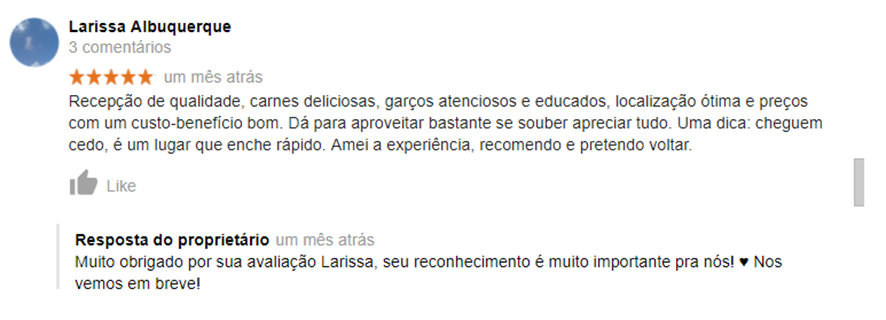
Notice that this is an excellent review. The customer highlights several positive aspects of the establishment and gives a tip for new customers. They conclude by saying they "loved it" (a very strong expression) and not only recommend it, but also say they intend to return.
The response given isn't bad, but it could be improved. The customer expressed great emotion and appreciation for their experience, and it's important to reciprocate that sentiment in your response.
Positive aspects of the response
- Mention the client's name;
- Thank you for your feedback.
- The answer is objective.
- He is kind and friendly.
- It encourages the customer to take action.
Negative points of the answer
- The important points mentioned in the evaluation are not addressed: mentioning these points makes the response more personal and authentic. Do you realize that the owner could easily have used "copy and paste" in their response?
- It doesn't mention the brand or keywords; this type of action improves SEO, helping your establishment appear first in search results.
- Using pre-written answers and the "copy and paste" command is tempting, as responding to assessments takes time, but it's not the best solution. Of course, using a template to speed up the work and maintain quality is possible , but remember to always personalize and understand each case.
How could the owner have responded?
When responding, try to match the customer's emotion. If they expressed a lot of enthusiasm, keep up the pace. After all, it was a great comment and deserved to be shared. Here's a suggestion:
"Hi Larissa, thank you so much for your feedback. We are very proud of our team of waiters, they are the best! We look forward to your next visit to the establishment. Please note that we also offer new services; I bet you'll really like them. See you soon!"
Checklist for how to respond to negative online reviews
- Call the customer by name;
- Thank you for your comment;
- Apologize;
- Be brief, direct, and objective in your response;
- Acknowledge the problem and ensure its resolution;
- Do not mention the company name;
- Don't be defensive;
- Ask the customer to update the review (when possible)
Response evaluation
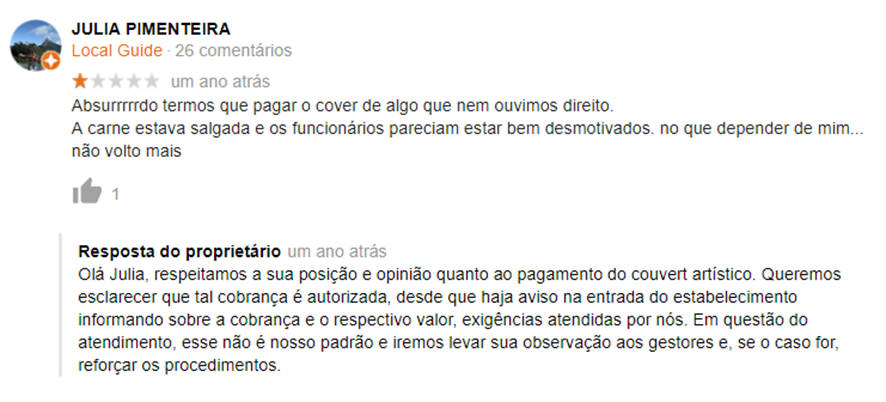
Notice that Julia, the customer, expresses her indignation by emphasizing the word "absurd." She also points out the two negative aspects responsible for her negative experience: the cover charge and the waiters.
Positive aspects of the owner's response
- Use the customer's name in the greeting;
- Acknowledge the problem and promise to take action.
- It does not mention the company's name;
Negative aspects of the owner's response
- He didn't thank the person for the comment: do you remember that you should always be kind and polite? Even if it's negative feedback, you should still say thank you.
- He didn't apologize: your client feels unhappy and frustrated, the least he expects is to hear an apology.
- The response wasn't brief: notice that the establishment tries to explain about the cover charge, and this unnecessarily lengthens the answer.
- The establishment took a defensive stance: faced with the two negative points highlighted by the customer, the establishment adopted a defensive posture. Note that the company explains the charge for the artistic cover charge, but Júlia is more dissatisfied with the quality of the cover charge and doesn't know if she was informed about the service fee or not.
Another instance is when the company mentions "if that's the case," which also puts your response on the defensive. Taking this stance is not advisable because it's the same as placing blame on the customer.
Other potential customers will see your response, and the impression they will get is of a company that shirks responsibility and blames its customers.
How could the owner have responded?
"Hello Julia, thank you for your feedback and we are very sorry for what happened. We will take action regarding the cover charge and investigate what occurred with the waiters' service, as this is not our standard. We hope to have another opportunity to impress you, see you soon."
How to respond to reviews without comments
Companies don't always receive positive reviews with detailed customer feedback. Sometimes they just give a rating. But, as we mentioned, you should respond to them in the same way
Highlight a positive aspect of the business
"Hello [Name], thank you for your feedback. We just finished renovating the pool, and now it's the largest in the area. It seems the renovation is going well. We hope to see you again soon. Best regards."
Highlight the company culture
"Hello [Name], we appreciate your feedback. We value the complete satisfaction of our customers, which is why we invest heavily in training our employees. We hope to see you again soon."
Offer a product/service
"Hello, thank you for your feedback, it's great to know you enjoyed it. Did you get to try the starred coffee? It's one of my favorites. I recommend it next time you come. We look forward to seeing you.".
How to respond to defamatory reviews
As we said, a defamatory comment is one based on false factual statements. Before responding to such content, analyze the importance and nature of the comment, its potential to cause harm, and whether a response could make things worse. Ideally, you should seek the help of a specialist.
If the content is indeed defamatory, contact the platform where it was hosted and request its immediate removal. According to the Brazilian Internet Civil Rights Framework Law (Marco Civil da Internet), a court order is not required for the removal of content from the internet.
And if you file a lawsuit, and a cybercrime is indeed proven, the defendant (author of the content) may be held liable for defamation, slander, invasion of privacy, or misuse of image, among other things.
Relevant statistics on the importance of online reviews
- 93% of consumers say that online reviews from other consumers influence their purchasing decisions. (Reviewtrackers Annual Research).
- Online reviews from other consumers are the top choice when it comes to trustworthy sources of information. (Kantar IBOPE Media survey)
- 57% do not trust establishments with less than 4 stars. (Bright Local)
- 98% of consumers read companies' responses to reviews. (Bright Local)
- 78% of consumers use the internet to search for information about companies more than once a week (Bright Local)
- 74% of consumers left reviews for local businesses in the last 12 months. (Bright Local)
- 67% of consumers consider leaving a review for a positive experience, while 40% consider leaving a review for a negative experience. (Bright Local)
- Improving ratings from 3 to 5 stars can increase Google clicks by up to 25% (Bright Local)
- Businesses with 5-star ratings received 69% of total clicks among top Google listings (Bright Local)
- 45% of consumers are more likely to choose businesses that respond to online customer reviews. (Review Trackers)
- Customer reviews impact 15.44% of Google search results. (MOZ)
- 80% of consumers consider it essential that the brand or product they are interested in has positive reviews from other buyers before making their decisions. (Consumoteca Group)
- 72% of consumers say that positive testimonials and reviews increase their trust in a business. (Big Commerce)
- 88% of consumers trust online testimonials and reviews as much as recommendations from friends or family (Big Commerce)
- 72% of consumers make a decision only after reading a positive review (Search Engine Watch)
How to respond to defamatory reviews
A defamatory review is when a comment is based on false factual statements. Before responding to such content, analyze the importance and nature of the comment, its potential to cause harm, and whether a response could make things worse. Ideally, you should seek the assistance of a specialist.
If the content is indeed defamatory, contact the platform where it was hosted and request its immediate removal. According to the Brazilian Internet Civil Rights Framework Law (Marco Civil da Internet), a court order is not required for the removal of content from the internet.
And if you file a lawsuit, and a cybercrime is indeed proven, the defendant (author of the content) may be held liable for defamation, slander, invasion of privacy, or misuse of image, among other things.
🎁 Bonus tip:
When responding, prioritize the most important reviews. Start by responding to negative reviews with comments, then respond to positive reviews with comments. After that, respond to negative and positive reviews without comments, in that order.
This way you ensure that assessments with the greatest potential for harm or gain are addressed first.
Conclusion
Online reviews are crucial for a good brand strategy and business reputation, and investing in their management is essential for your company's results and for attracting new customers.
Whether positive or negative, receiving feedback is very good for business, and you need a strategy for your responses to capture the potential it has to offer.
Now that you know more about reviews, we want to help you even more, so we've prepared a guide with over 80 examples on how to respond to all types of customer reviews. Access the material and master the art of responding to reviews and strengthen your brand and your stores!