
The overall goal of a local SEO strategy is to establish the store as the most trusted authority for Google searches related to its products and/or services within a specific geographic area.
With the rise in searches using the term "near me," it's crucial to create a local SEO strategy to optimize your online visibility and drive traffic to your physical store.
In this article we will show you how.
What is Local SEO?
Local SEO , or Local Search Engine Optimization, refers to strategies that help businesses promote and market their products and services to local and nearby consumers.
Local SEO serves to increase the visibility of local businesses in search results targeting local intent, bringing more customers to the establishment.
Local SEO, because it has a geographic component, focuses on building an online presence in a local area. For example, if you search for pizza, local pizzerias will rank higher than pizzerias that are several kilometers away.
What is the importance of a local SEO strategy?
Creating a local SEO strategy is important because, in today's world, the customer journey begins online. According to industry data, 81% of consumers conduct online research before physically entering a store.
Another important behavioral change, reported by Google, was the 75% increase in searches using the term "near me" in Brazil .
Today we see a great need to find local businesses, and that makes a lot of sense. For example, you want to go to the dentist. But nobody wants to spend an extra 45 minutes going back and forth when there are good dentists available everywhere. So now consumers are searching on Google for local establishments.
That's where a local SEO strategy comes in, because Google will only show the most relevant locations to the consumer at the top of the search results.
Having a local SEO strategy is important for this reason, so you can appear in the top positions in search results for local intent.
What is a local SEO strategy?
A local SEO strategy aims to optimize the online presence of a local store in Google search results for potential customers near it.
In this strategy, you will make several changes aimed at improving local SEO in order to secure a place in Google's Local Pack.
If you search for a specific type of business or service on Google, the first thing to appear is the Local Pack. It's basically the Google Maps area that appears on the search results page and shows a list of the most relevant businesses – but there's only room for 3 businesses!
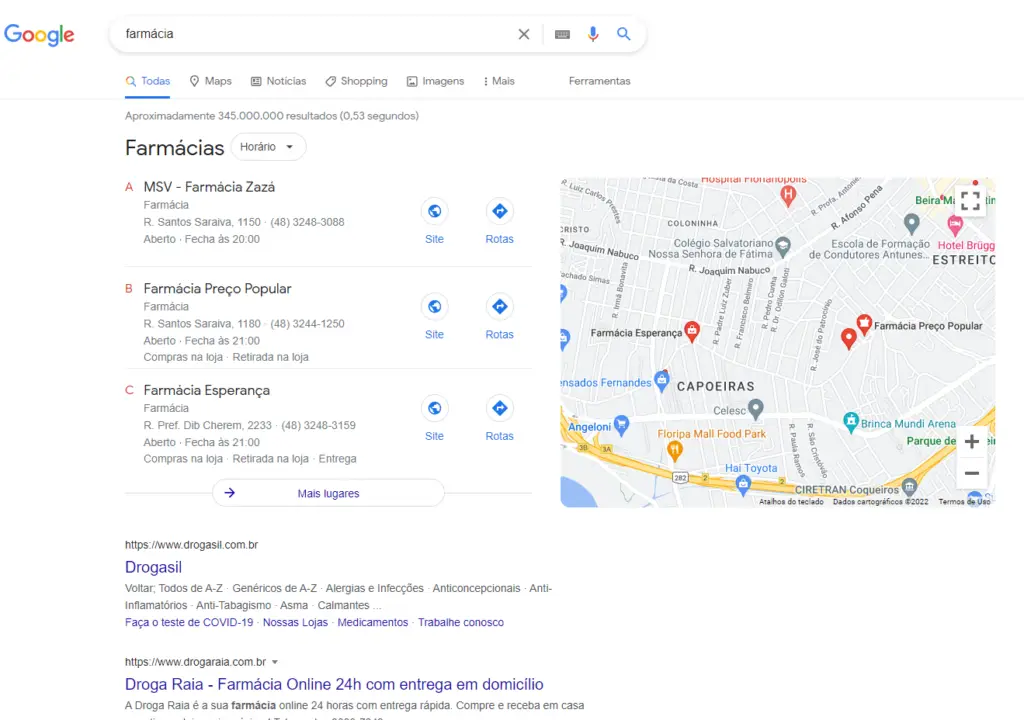
If you don't have an SEO strategy to appear there, you're at a disadvantage compared to your competitors who already have one.
Local SEO Ranking Factors
According to Google, there are three factors that matter: distance, relevance, and prominence.
Distance: The closer you are to your customer, the higher you will rank in "near me" searches.
Relevance: The more relevant your company is to the consumer's search, the higher your ranking will be in search results.
Highlight: This factor works slightly differently from the other two factors. If you have great customer reviews and a good reputation score, you will rank higher. For example, if you have a fashion store with a 4.9 rating and many positive reviews, you are likely to rank higher in local search than a competitor with a low rating and few reviews, who is closer to the customer.
How do you create a local SEO strategy for your store?
Basically, Google wants to confirm that you are who you say you are,that you do what you say you do, and that you are located where you say you are. You do this by providing as much information as possible about your business – complete and up-to-date information!
We already know that the factors Google considers for ranking are: distance, relevance, and prominence, and research done by Advice Local has pointed out the factors that can positively impact local SEO.
Top 3 factors that will improve your local SEO ranking
Check out these 3 factors that can boost your ranking in local search results:
- Google My Business 36%
- Reviews 17%
- Signs on-Page 16%
Other factors:
- Link 13%
- Quotes 7%
- Behavioral 7%
- Customization 4%
(You can check out the full research in English here )
Adding together the influence of Google My Business, reviews, and on-page signals, they represent 69% of the impact on a local SEO strategy. So if you work on these 3 factors very well, you have a great chance of reaching the top of the search results!
The idea here is for you to understand the reasoning behind the algorithm and be able to conduct your own local SEO tests, always remembering that you need to be relevant to the consumer, and thus you will be relevant to Google.
Below are some strategies that will help you with this.
5 local SEO strategies to implement now
1) Have a profile on Google My Business
Having a Google My Business (GMB) profile is the first step because GMB is your digital storefront for locally targeted searches. Just to remind you: it impacts up to 36% of local SEO.
As obvious as it may seem to tell you to have a GMN account, many professionals still don't give due importance to the step of filling out the information to have the most complete and up-to-date profile possible.
Google wants you to share as much information as possible about your business, what services you offer, everything you can answer on your Google business profile.
The more information you provide to Google about your store, the more relevant it will be in search results. This includes not only a correct and up-to-date address, phone number, and opening hours, but also images, posts, answering customer questions, and especially a high number of positive reviews and a high reputation score.
This post here has a topic with 7 tips to help you have a much more optimized Google My Business profile, check it out!
2) Ensure your Name, Address, and Phone number information is standardized
Name, Address, and Phone Number (NET) are very important from a local SEO perspective and are part of on-page optimizations, which impact SEO by 16% , but many professionals still fail in this regard
You need to pay attention to whether your NET information is standardized wherever it appears on the Internet, from your corporate website to your GMN profile and other websites.
Google and other search engines cross-reference all these NET occurrences and reward companies that maintain a consistent and accurate profile.
For example:
- 🟢 CORRECTGood Price Pharmacies
- This is correct because it only contains the company name information. If you have more than one unit, maintain the same name format across all listings. This will strengthen the network's SEO.
- 🔴 WRONG! Good Price Pharmacies – São José – Florianópolis
- Please note that we have the company name followed by the location; this is incorrect. There is a specific field for entering the address.
- 🔴 WRONG! Good Price Pharmacies | Pharmacy, Medicines, Generics, Perfumes, Cosmetics and Personal Hygiene
- Note that we have the company name followed by a list of keywords. Do not include any keywords next to your business name. After the release of the Vicinity Update, Google began penalizing companies that use this practice.
3) A network or franchise with multiple units
If you are a business with multiple locations, you need to have a GMN profile for each store. Google considers each location individually as a separate entity and separate business, so if you are a chain, you need to have a GMN profile for each location.
A major advantage for companies with multiple stores is the number of pages with addresses pointing to the corporate website.
For example, if you have 500 stores, you'll need 500 separate pages on your website, clearly indicating each location with address and phone number information (and a map if possible). All this information makes you more relevant in the eyes of Google.

Great tip! When setting up your business profile on Google Business Profile (GMN), you'll be asked to add your website URL, but that's where many people make a mistake. Most people add the URL of their website's homepage to their Google Business Profile, but this is incorrect. Instead, add the landing page for that specific location, not your homepage.
4) Keywords
I mapped and identified keywords with local intent and which ones are leading consumers to find your store's profile.
GMN offers you a space to describe your business in 750 characters. When describing your company, make strategic use of the keywords you have identified.
For example:
"Harmo is the most complete Experiential Marketing platform in Brazil, perfect for use in Retail Chains with physical stores . We are the only 3-in-1 solution that integrates Digital Presence Management ( Google My Business , Facebook Local, TripAdvisor, iFood ) , Reputation Management (Public Reviews), and Customer Satisfaction Survey Management ( NPS, CES, CSAT ), creating a powerful lead generation machine. Listen, interact, analyze, and act focused on customer needs throughout their entire journey , transforming your customers into the main channel for acquiring new clients. Harmo, Experience is the new Marketing ."
5) Google Reviews – Promptly request and respond to customer reviews
It's no coincidence that reviews are the second biggest factor impacting local SEO (17%). According to Birdeye, 92% of consumers consult online reviews before making a purchase decision.
When customers search for the best local businesses near them, Google aims to provide the best results. To do this, Google takes into account the same factors that customers do to determine a business's trustworthiness. Because customers trust reviews, Google's algorithm trusts them too.
Therefore, you need to have a good customer review management strategy. Here we will address the main points to keep an eye on.
But first, it's important that you understand the role of reviews in the customer journey and for Google's algorithm.
When a customer reviews your store on Google, whether positively or negatively, they are providing Google with some very important information:
- If the company is a legitimate operation;
- If it has real customers who interact with it;
- How well does the company serve its customers?
- User-generated and updated content.
How to use Google reviews to improve local SEO:
1) Always ask for customer reviews
Customer reviews are user-generated content, and this type of content has a strong influence on Google. Furthermore, you'll have fresh, new content on your page every day.
Each review is social proof of the good experience delivered by your store, services, products, and customer service, so the more positive reviews, the better.
Positive reviews also contribute to a higher reputation score, and the more positive reviews you receive, the better.
Therefore, have a strategy for requesting customer feedback.
2) Answer each assessment appropriately
A company's responsiveness is reflected in the customer experience, customer service, and overall perception of the company.
Respond promptly to all reviews, especially negative ones. 45% of consumers say they are more likely to visit a business if it responds to negative reviews. (source: Online Reviews Statistics and Trends: A 2022 Report by ReviewTrackers)
Take advantage of the opportunity to respond to a review to index terms important to your business and further strengthen your local SEO. Respond using keywords that are strategic for your business.
Check out this checklist on how to respond to Google reviews
A) Always thank them for their feedback! Regardless of whether it was positive or neutral.
B) If the evaluation was negative, acknowledge the problem and apologize for the negative experience. Don't try to over-explain; trying to justify or question the customer will irritate potential customers who read the response. Respond by putting yourself in your customer's shoes and thinking about how good you will look by showing that you accept criticism because you always want to improve to better serve your customers.
C) Repeat the positive points that the client wrote, thus reinforcing the SEO.
D) Always use your company name in responses to positive reviews.
E) However, never include the company name in your responses to negative reviews. You don't want your company name associated with negative experiences in search results.
F) Use and overuse keywords, highlighting their qualities and strengths.
G) Offer new information in your answers; after all, thousands of people will read your responses and learn about the latest news, which can generate more sales.
H) Never use pre-written, copy-and-paste responses. Copying and pasting is worse, much worse, than not respondingat all, because it sends the following message: "All I want is to get rid of these reviews, I don't care what you (the customer) are saying about me."
See how it's possible to respond to evaluations with a more strategic approach?
Conclusion
Google's algorithm is constantly updating to better meet consumer search requests. But online customer reviews will always be your best social proof of relevance.
It's worth noting that to be relevant to Google's algorithm, you must first focus on being relevant to your customer. Offer a good experience and encourage them to review your store.
We hope this article has been helpful. And if you need solutions to make the process more efficient, we'd be happy to assist!
Here at Harmo, we are the leading authority in local SEO in Brazil. Feel free to schedule a 25-minute meeting with us.