
Customer satisfaction research is an essential technique for companies to understand public perception of the company and to develop strategies based on customer feedback.
Even though employees and entrepreneurs are always aware of their problems and know what needs improvement, there's no one better to point out mistakes and successes than consumers, right?
The opinion of the person on the other side of the table makes all the difference and should be considered by companies; after all, it is very valuable and provides great direction.
Are you using customer satisfaction surveys correctly in your company? Have you adopted any strategies and are you actually using the results? Check out our post and learn what you need to know to do it right!
What is customer satisfaction research?
Customer satisfaction surveys are essential to help companies understand what customers think about their brand, product, or service. They typically consist of 5 to 10 questions.
Customer satisfaction research is a strategy whose main function is to receive feedback from customers. And this feedback is translated into improvements and opportunities for the business.
Collecting customer feedback helps a company gain a deeper understanding of its customers, knowing their pain points, perceptions, and expectations regarding the brand and what it delivers. It allows the company to learn more about the customer and their perceptions, expectations, and satisfaction with what the company provides.
There are various types of research that can be applied, but they all have an objective, hypotheses, and require a minimally relevant sample size to evaluate the results.
The objective is the first step in conducting research; after all, without knowing what you want to find, it's difficult to formulate questions and choose data collection channels, isn't it?
Next, it's necessary to define the hypotheses. These relate to what impressions and results you think you will find at the end of the research. They will help during the analysis and even in defining the questions.
Finally, after understanding the objective of what you are seeking, you need to define who the research will be directed towards and calculate representative samples.
What are the benefits of customer satisfaction surveys for your business?
Customer satisfaction research can be conducted with both external audiences (customers) and internal audiences (employees), as both are very valuable to organizations.
Regardless of which audience you choose, customer satisfaction research guarantees several benefits. We've highlighted a few for you below! Check it out!
It helps you learn more about your customers
Working with the customer journey and customer experience is the strategy of the moment, so it's essential to always know more about your audience. Most of the time, a satisfaction survey offers insights so your team can focus on meeting (and possibly exceeding) customer expectations.
Furthermore, it's possible to ask specific questions and learn even more details about your personas. There are many possibilities for discovery, and certainly, each piece of information is very valuable for future actions.
Understanding what your customers value in your company is a key point in defining and prioritizing the next steps for your product or service.
It highlights opportunities and areas for improvement
Discovering information directly from customers is a major competitive advantage for businesses. After all, with this data, managers can base their decisions on and create investment strategies that are truly worthwhile.
More than that, it's possible to identify and understand what needs to be addressed more quickly, what opportunities need to be seized, and what improvements should be made to the business.
We can also mention competitive analysis, which should be done to measure the strengths and weaknesses of competitors.
Having data allows companies to set aside guesswork and make strategic decisions with more confidence.
Greater customer retention
There's nothing worse than a dissatisfied customer, who can become a detractor of your brand. However, unfortunately or fortunately, they are also very useful in pointing out potential problems that could affect the future of your company and even other customers.
If you have a defined plan to measure customer satisfaction regularly, you will likely identify these changes and indications of problems much sooner than you would if you weren't using these indicators.
A large portion of your dissatisfied customers will not complain about what is bothering them unless they are asked to do so.
In his book "Management and Marketing," Philip Kotler shows that 95% of dissatisfied customers don't complain; they simply switch suppliers (and never come back!).
In other words, if a customer complains, it's because they care about remaining your customer. And that should be taken into consideration.
Showing your customers that you understand their problems and are already working on them will significantly improve customer retention. Furthermore, having (and maintaining) satisfied customers increases the likelihood of repeat purchases, as well as increasing the overall customer lifetime value.
Therefore, the sooner a company starts listening to its customers, the greater its chances of discovering its shortcomings, recovering lost customers, and seeking to win over new ones.
How do you implement a customer satisfaction survey from scratch?
There are various forms and applications for customer satisfaction surveys. It's not necessary to choose just one strategy; the key is to combine multiple channels and reach customers in diverse ways, according to the context and questions that make sense for your business.
The first step in conducting a customer satisfaction survey is to consider when you want to collect this feedback. The important thing at this stage is to think about your customer's journey and the steps they need to take to complete a cycle – this will be the best time to administer the survey.
Here are some common application scenarios:
- Post-sales service (finding out about the customer experience and through which channel they reached your brand)
- Post-installation/maintenance;
- After receiving the product/service;
- After a period of time interacting with your product/service (using NPS)
- Post-care;
Once the timing for conducting the research has been determined, the next step is to choose the best approach or indicator to collect customer feedback.
Check out the most effective research you can use to understand your customers
NPS (Net Promoter Score)
NPS , is a metric developed to measure and understand customer loyalty levels. Its goal is to determine a consistent and easily interpretable score that can be compared over time or across different industries.
The idea is simple: if you enjoy using a product or doing business with a particular company, you want to share that experience with other people, right?
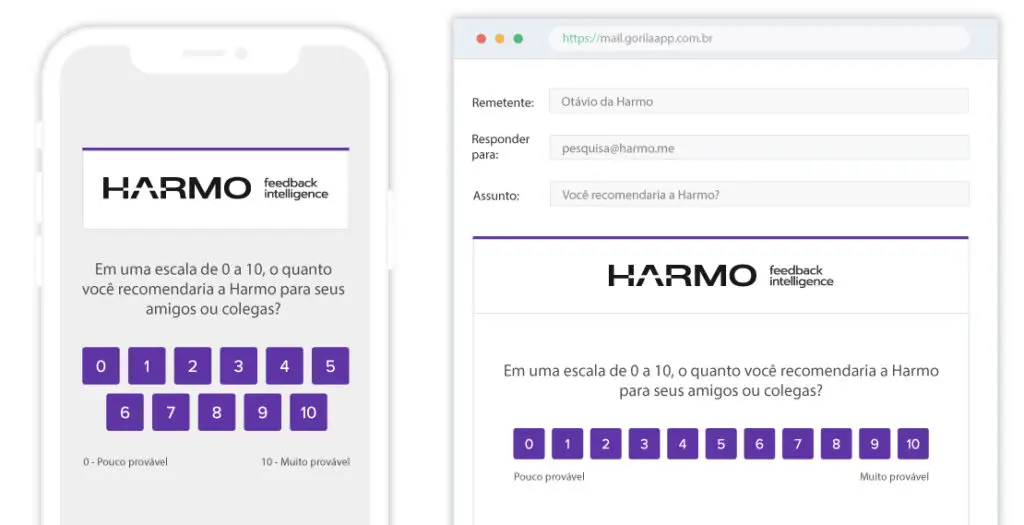
💡 An NPS software like Harmo can help you learn more about your customers' needs.
CES (Customer Effort Score)
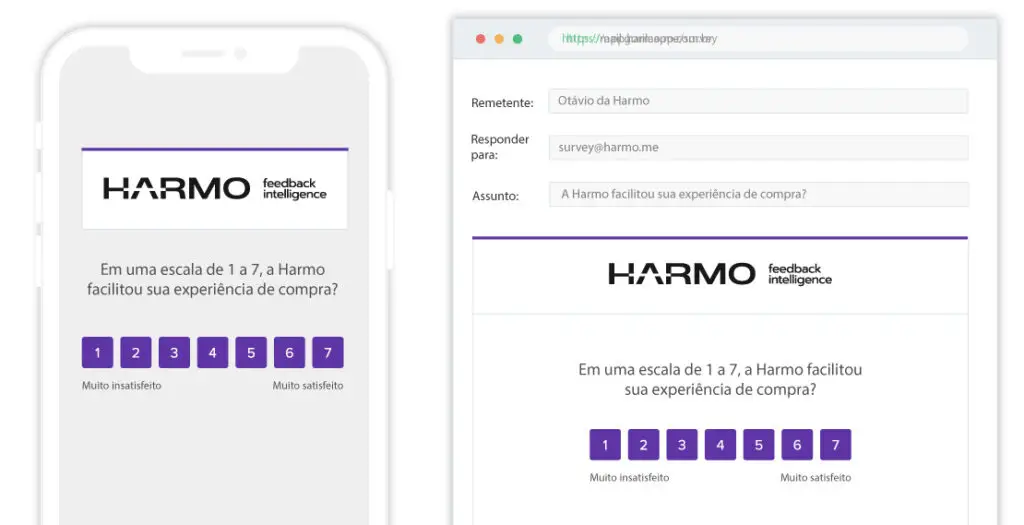
Customer Effort Score is a metric used to measure the level of effort a customer had to put into resolving a specific problem with your company.
In other words, the more effort a customer needs to make when interacting with your company, the worse their experience will be, and consequently, you will be dealing with a future ex-customer.
The Customer Effort Score question is on a scale of 1 to 7, which asks:
CSAT (Customer Satisfaction Score)
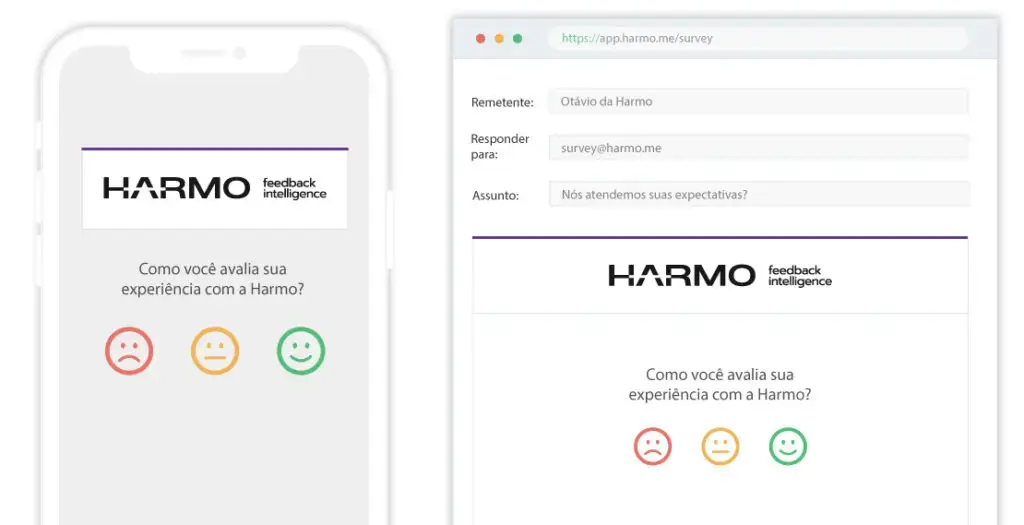
The Customer Satisfaction Score is a metric that directly measures customer satisfaction levels in specific interactions, and is measured using a numerical scale that asks:
Customized templates for customer satisfaction surveys:
Templates for general customer satisfaction:
- How satisfied are you with our company? (Very satisfied/Satisfied/Neutral/Dissatisfied/Very dissatisfied)
- On a scale of 0 to 10, how likely are you to recommend us to a friend? (NPS)
- Did the company make it easy to resolve my problem? (CES)
- What are the expected results for your company this year, and how would you like us to help you achieve your goals?
- How important is our solution to your company? (1 – 5)
Templates for customer service:
- On a scale of 0 to 10, what score would you give our product/service?
- Did you feel well treated and welcomed by our customer service team? (Yes / No)
- How effective was our support team in resolving your issue? (1 to 5)
- Did our team understand and resolve your problem satisfactorily? (Yes / No)
- Regarding the time it took you to be served, our service was: (Long / Moderate / Fast)
Templates for functionalities:
- On a scale of 0 to 10, how would you rate your experience with our product/service? (CSAT)
- What aspects of our product/service are essential to your daily operations? (Multiple choice or descriptive)
- Is there a specific feature of our product that you find more difficult to understand? Which one? (describe)
Conclusion
Regardless of which strategy your company chooses for customer satisfaction research, it's important to remember that more than just collecting data, it's necessary to actually use it to improve and benefit customers.
Collect data, analyze and extract information, understand your customer profiles, and develop plans that enhance the customer experience, whether in contact channels, marketing, sales, logistics , or any other area of the company.
Customer satisfaction surveys can provide different insights and many solutions in the short, medium, and long term. How have you been addressing this issue within your company? How important is customer opinion to you right now? I hope this content has helped you in this regard.
Now that you know a little more about customer satisfaction research, get your hands dirty and take the opportunity to learn more about customer relationship management and its importance. Until next time!
Check out our webinar: The 4 main metrics and which one to use at each stage of the customer journey.