
Customer satisfaction is one of the most important factors for the success of any business. Companies that manage to meet their customers' expectations are more likely to maintain their loyalty and recommend their products or services to others.
One of the most effective ways to measure customer satisfaction is through CSAT, or Customer Satisfaction Score. CSAT is a metric that measures customer satisfaction in a specific interaction.
Widely used by customer service teams, there are three main metrics for measuring customer experience: CSAT, NPS , and CES.
All three aim to extract customer opinions through carefully designed surveys that seek to measure levels of customer satisfaction, loyalty, and effort.
Since we already have materials discussing NPS and CES, it's time to explain CSATand how this metric can be applied to your business.
Let's go?
What is CSAT and what does its acronym stand for?
CSAT question that asks the customer how they rate their experience with a particular interaction. The customer's response is usually measured on a scale of 1 to 5, with 1 representing "very dissatisfied" and 5 representing "very satisfied".
Since CSAT has a transactional nature, this means it should be used to measure how satisfied your customers are with an action taken by your company or with certain aspects of your products or services.
It can be used at various points in the consumer's buying journey, such as after a purchase has been made on the website.
It can also be used to measure the degree of satisfaction with some more specific aspect that one wishes to analyze, such as delivery time, shipping cost, payment methods, service provided, quality of customer service, among countless other possibilities.
Furthermore, CSAT is a great way to understand sentiment in relation to a particular experience.
With this data, you will have the power to ensure that your customers are satisfied with how you solve their problems, or to promote improvements in areas where there are deficiencies.
💡 Understand the difference between the main customer experience metrics
CSAT Question: Understand the difference between your questions and applications
Not all CSAT surveys are created equal. Depending on how the survey question is phrased, teams can get very different feedback from their customers.
If you want customers to focus more on the service aspect, specify that in the question. If you're more interested in the overall perception of the experience, the question can be more open-ended.
Try different types of questions to identify which ones give you the clearest and most actionable feedback for your customer service team. Check out some examples you can use.
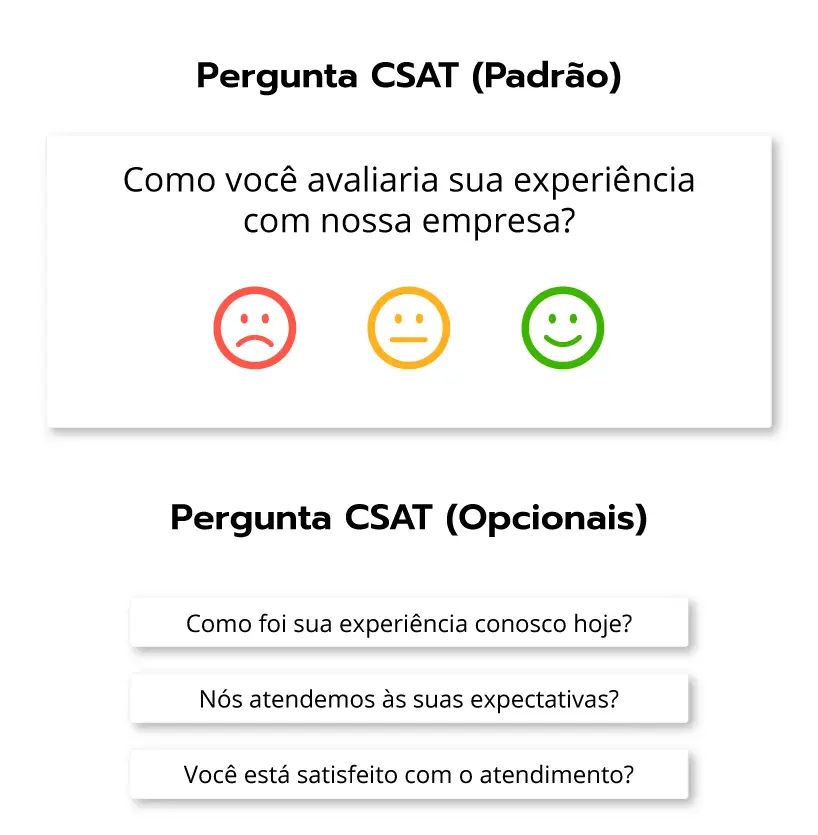
After your customer answers your main CSAT question about their satisfaction level with a particular interaction, it's time to request more qualitative feedback to further enrich your research.
The follow-up question gives your customer the opportunity to better express their experience with your solution; that's why many customer success consider the follow-up question a key part of the survey.

CSAT Calculation: Understand how to calculate this metric
As you might imagine, there are several ways to calculate CSAT because there are different ways to measure this score. The lack of a specific definition means that companies can adapt the measurements to suit the needs of their own business.
Therefore, customer satisfaction scores can be measured in five ways, which are:
- Yes and No – 1 and 2 (binary)
- Dissatisfied/Neutral/Satisfied – 1 and 3
- 1 to 5 (Likert scale)
- 1 to 7 (Likert Scale)
- 0 to 10 (Likert scale)
The way you measure it depends on your strategy and what best suits your needs. There is no better or worse measurement, as long as you ask the right question.
Because CSAT is a transactional metric, the only thing you need to know is whether your customer is satisfied or not.
If you choose to calculate CSAT on numerical scales such as 1 to 5, 1 to 7, or 1 to 10, you will need to calculate the weighted averageby adding all occurrences and dividing by the number of respondents. See the image below for an example from 1 to 10:
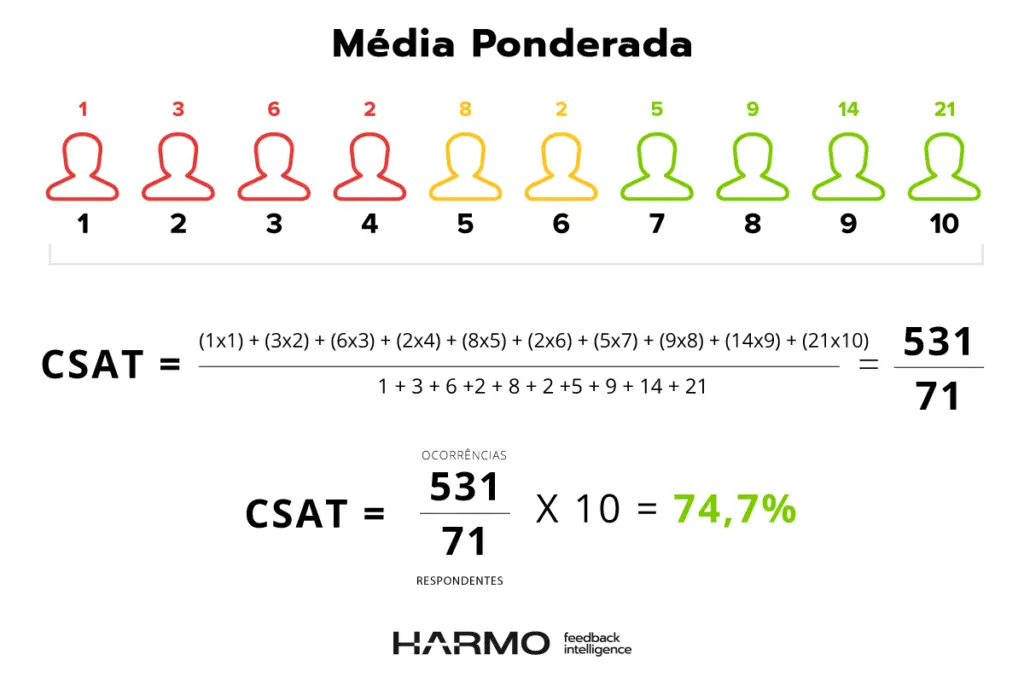
PS: This weighted average model can be applied to all models that are on the Likert scale.
But if you choose model 1 and 2, or 1 to 3, the calculation becomes easier, as you basically have to subtract the percentage of satisfied customers from the percentage of dissatisfied customers . See the image below:
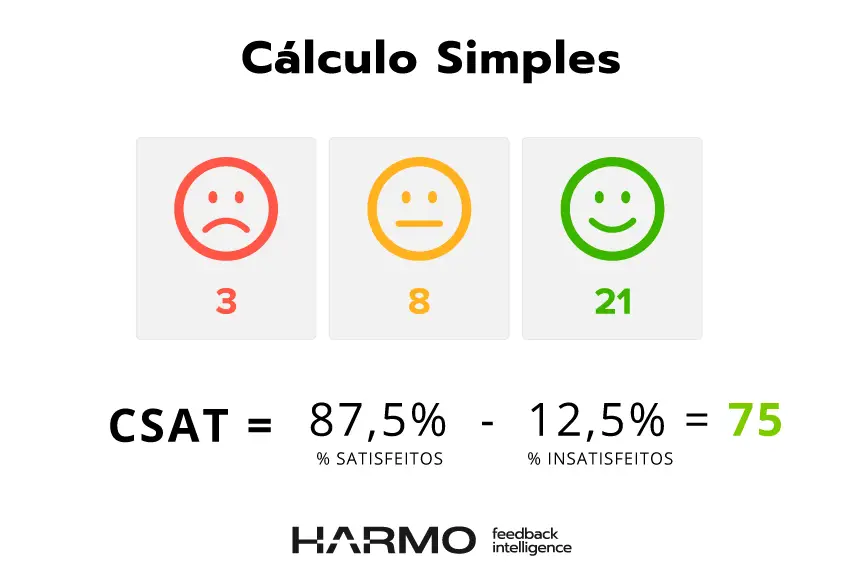
If you would like to check out the other measurement modes, click here.
When should you use CSAT in your business?
Since CSAT is a transactional metric, it is used after specific interactions to measure customer satisfaction in the short term.
Therefore, the CSAT question can help you collect meaningful data at any stage of the customer journey, and is especially useful after the following customer touchpoints:
- Customer service interactions (phone, live chat, email, social media);
- Registration for programs or services;
- Website visits;
- Training and onboarding;
- Online checkouts;
- Meetings with clients or consultations;
- Feedback from the conference and event;
One of the great strengths of this metric is its simplicity. Therefore, when you identify customer satisfaction levels, it becomes easier to close the loop on a customer interaction.
And if for some reason the experience was not satisfactory, it is easy to identify that moment and take steps to remedy that interaction.
Not only that, but you can track satisfaction throughout the entire customer lifecycle very easily using customer satisfaction scores.
Because it's such a quick survey, you can conduct multiple experiments throughout a customer's journey and gain a comprehensive understanding of how the customer feels at various touchpoints during the process.
This makes it easier to identify potential bottlenecks and improve the customer experience.
Why use CSAT? Understand the reasons for implementing this metric in your business
It's very important to know what your customers think about your company, what the positive aspects are, and what needs improvement.
Here are some points that explain the use of CSAT:
#1 Simple and fast
A single question is enough to determine your customer satisfaction score, with the possibility of being linked to a follow-up question.
A single question is enough to determine your customer satisfaction score, with the possibility of being linked to a follow-up question.
#2 Quantifiable
Management will have tangible data and will see how well their company is performing with a simple metric. The method is easy for everyone to understand.
#3 Versatile
It allows you to understand customer satisfaction in general and also in specific interactions, in addition to being easily understood by users and usually having good response rates.
#4 Comparative
Because it is a simple metric, it is easy to benchmark across departments and branches of the company. For example, establishing that the average CSAT for customer support should be equal to or greater than 80%.
#5 Is CSAT complementary to other metrics?!
In addition to being a very powerful transactional metric, CSAT can be associated with other metrics such as NPS and CES, providing an overview of your customer's experience with different aspects of your service.
When comparing different customer experience metrics, we can conclude that each one has its own applicability, which is why they complement each other and provide more insights when applied together.
For example, we could imagine a survey to measure satisfaction among participants of a recent event you organized.
When creating a survey, you can ask respondents to fill out some questions regarding their satisfaction (CSAT), divided into different areas of the event (satisfaction with the content, food, quality of the speakers, location, etc.).
Additionally, you could ask the CES to assess the effort your customers needed to register for the event. At the end of the survey, you can ask how likely your customers are to recommend the event to friends and colleagues (NPS).
Now we're talking about a complete way to measure and analyze your customers' satisfaction.
Step-by-step guide on how to implement CSAT:
The application of a CSAT survey is very similar to a CES, as both operate in a transactional manner. All you need to know about CSAT is that this metric is used to measure customer satisfaction, and it works best in specific interactions.
With that in mind, let's get down to business:
#1 Contact Point
The first step is to define which touchpoints you want to measure. This question can help you gather more meaningful insights at any stage of the customer journey, such as:
- Customer service interactions (phone, live chat, email, social media);
- Registration for programs or services;
- Website visits;
- Training and onboarding;
- Online checkouts;
- Meetings with clients or consultations;
- Feedback from the conference and event;
#2 Choosing the channels
Depending on the platform you use, the question will be sent in a different way. If you use more than one channel to contact the customer at this point in the buying journey, test them! Testing is the only way to identify the channel with the highest response rate.
In other words, try requesting an answer to your question via email, SMS, website, app, chat, or whatever else is possible.
#3 Submit your research
CSAT is generally measured transactionally. This means that the time to ask the customer for feedback is after the end of each cycle. With this in mind, you should set up your automation and send the survey after a specific event that you choose, according to the touchpoints you selected in item 1.
#4 Analysis and optimization
Now that you have the data from your quantitative question and also from your follow-up question, it's time to analyze the results.
You will realize that this analysis step should be done periodically so that you can quickly analyze the feedback collected and close the loop with your client.
As you can probably imagine, analysis is the fundamental step in identifying which touchpoints are weak and planning improvements based on that feedback. Of course, gathering this data has an ultimate goal: to act to improve your relationship with your customer.
Therefore, this final stage requires three main actions:
- Analyze your results: what do the numbers say about your situation?
- Act based on the results: what can we do to improve the situation?
- Optimize your research: how can we gather even more accurate data?
Conclusion
CSAT research is an excellent tool for measuring customer satisfaction at specific touchpoints. This specificity allows a company to improve very tangible and segmented aspects of its business. Furthermore, CSAT scores show teams the impact of their actions on customers .
Unlike NPS, CSAT doesn't offer an overview of the customer experience or their loyalty. Instead, it only tells you how your customer feels about specific interactions with your service.
Even if a customer says they had a good experience with your support team, you don't know if they would recommend your company to friends or family.
What you need to keep in mind is that no single measurement can adequately address all the elements you are trying to solve in terms of customer satisfaction and experience.
Therefore, you need to combine different customer experience metrics and discover, through testing, which one is the most effective for your company.
Keep improving month after month and you'll see solid returns in increased customer satisfaction and business growth. If you need help creating a comprehensive strategy to measure customer experience, get a free consultation with our expert!