
As a leader in customer service, you aim to make the customer's life easier, right? In this content, understand the Customer Effort Score metric to grasp how customer effort impacts revenue and customer loyalty.
But taking a step back, it's a fact that most customer service professionals are familiar with the two most popular metrics: Customer Satisfaction Score (CSAT) and Net Promoter Score (NPS). However, both metrics give companies insights into team performance and help clarify the strengths and weaknesses that affect the overall goals of their business.
But on their own, these metrics can miss an important part of the customer experience – how much effort customers need to put in to get their problems solved.
Due to its simplicity and high predictive power compared to other metrics, these characteristics make the Customer Effort Score (CES) a good measure for any type of work focused on improving a company's customer service.
As this concept gains traction in customer service, let's discuss what it is, how it can improve your service offerings, and the steps you can take to start using CES in your organization.
What is Customer Effort Score (CES)?
The Customer Effort Score is a research metric used to measure the level of effort a customer had to put into resolving a specific problem with your company.
Since its introduction, the metric has been gaining popularity because it focuses on the company's performance when it comes to dealing with customer issues.
The concept of customer effort gained attention in 2010 when the Harvard Business Review published an article titled "Stop Trying to Delight Your Customers." In it, the authors explain that companies should focus less on "delighting customers" and more on solving problems quickly and effectively.
In this study, HBR found that the most frustrating customer experiences were those involving multiple channels and interactions, such as:
- To re-explain a problem;
- Switching from web to phone;
- Transfer to another representative;
- Contact the company repeatedly about the same problem;
In other words, the more effort a customer makes, the more likely they are to abandon your brand.
What is the difference between CES and CES 2.0?
Initially, when the metric was created in 2010, it operated on a scale of 1 to 5, and was difficult to understand because the scale was inverted, with 1 (Little effort) and 5 (Much effort).
Furthermore, this first version also had considerable difficulty in its interpretation. Benchmarking the original CES was difficult because "effort" can mean so many things depending on the context. The original question was:
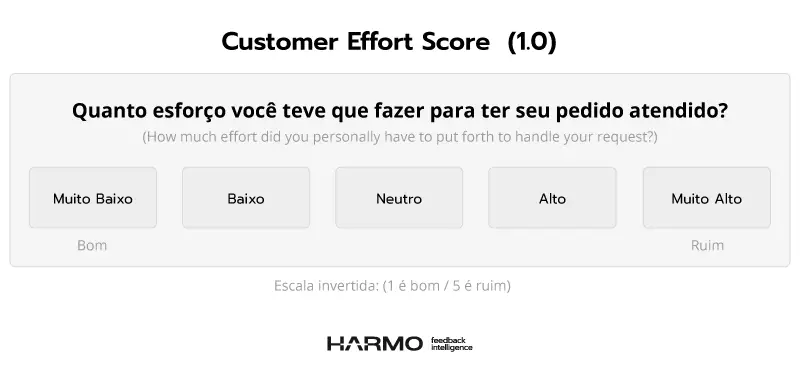
But in 2013, the Customer Effort Score was redesigned to version 2.0, this time on a scale of 1 to 7. In this new version, the metric proved to be much more reliable, less prone to misinterpretation, and is on an agreement/disagreement scale, in addition to being easier and more direct.
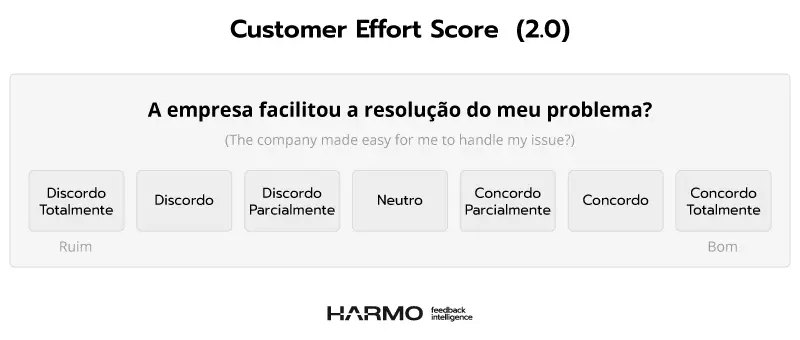
CES Calculation: Understanding Customer Effort
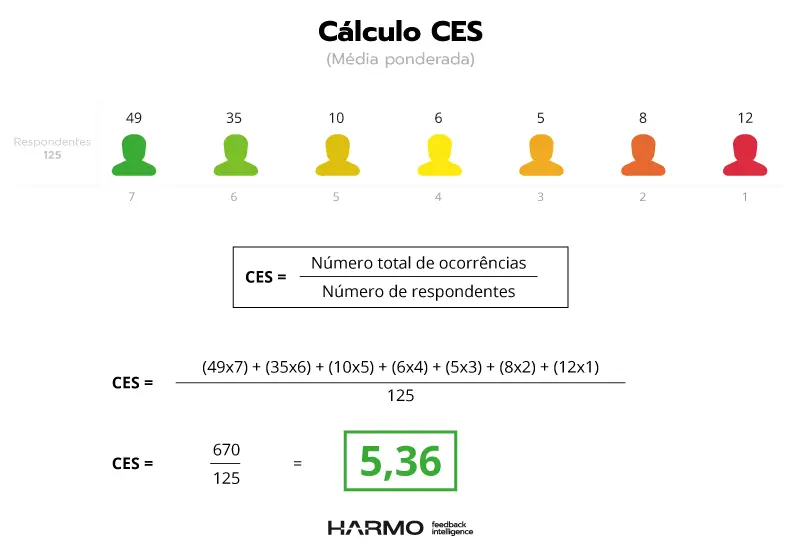
There are several ways to calculate customer effort, as it depends on the question you're going to ask. Assuming we're talking about version 2.0, we'll specifically discuss the average score, which is the simplest approach.
All you need to do is take the weighted average of all the scores to determine a score of 7. The higher the score, the less effort was put in (in this case).
P.S.: Since we're talking about weighted averages, don't forget to calculate all occurrences.
To simplify the difficult words, see the image below:
What constitutes a good effort score?
There's no set rule for a good customer effort score, precisely because there are different ways to measure this score. Generally, you want to move all customer ratings toward the lowest possible effort. Ideally, you should keep your score above 5.
Although CES isn't a metric you should measure and feature prominently in your campaigns like NPS, it will allow you to identify areas where your customers are struggling, and based on that feedback, your team should implement improvements.
Measuring customer effort in my business
#1 Identifying the touchpoints
The first step in implementing Customer Effort Score is to determine which touchpoints you want to measure. This question can help you gather more meaningful insights at any stage of the customer journey, such as:
- Customer service interactions (phone, live chat, email, social media);
- Onboarding;
- Purchases or sales interactions;
- Registration for programs or services;
- Website visits;
- Online checkouts;
- Meetings with clients or consultations;
#2 Choosing the channels
After choosing the touchpoints you want to measure, it's time to think about how you want to collect that feedback.
For example, if you want to map your customer's effort throughout the buying journey, you need to send a survey after they complete the purchase. This way you can identify if your system is accessible to everyone.
#3 Analysis and optimization
Analysis is the crucial step for you to identify which touchpoints are weak and plan improvements based on that feedback.
If you've identified that your customers are rating a particular action as requiring too much effort, it's time to mobilize the team to improve that interaction.
PS: A key advantage of using more than one metric in your business is that you can perform analyses by cross-referencing data. See the following example:
Let's say you have a serious problem with customer effort, and they're not satisfied with your solution. After you make improvements to the touchpoint where your customers were having difficulty, you see an increase in NPS and CSAT. This shows you how customer effort influences satisfaction and loyalty.
Conclusion
Implementing the Customer Effort Score metric is very powerful and will help you discover areas where the customer experience can be much easier, providing the raw data you need to drive changes in specific areas.
Building an customer service-based experience will win many fans for your company. When you focus on eliminating problems and removing obstacles to help, you make doing business easier.
When planning your research approach, remember how each metric (CES, CSAT, and NPS) offers unique insights into the customer experience. Measuring any one of these three is a great start, but you'll get the most actionable feedback by measuring all three together.