
Every day, millions of consumers use Google to find restaurants, cafes, pharmacies, supermarkets, gas stations, clothing stores, clinics, and much more. In Brazil, it is estimated that searches for local businesses represent half of the total volume of searches performed daily on Google . The 2025 edition of the Local Decision survey , an initiative of Harmo in partnership with Reclame AQUI, aims to understand the degree of influence that reviews exert on the choice of physical store when the consumer performs the search using Google or Google Maps.
Research results confirm that publicly shared reviews on Google are definitively integrated into the new omnichannel journey, especially when consumers want to make a purchase in a physical store. At the moment of choice, the store with the best reputation, that is, the best-rated, has an advantage and manages to attract more customers.
Another point worth highlighting is the confirmation of the relevance of Google Business Profile (popularly known as GMB or Google My Business) as a tool for attracting customers from online to physical stores. Managing the store's profile on GMB is essential for those operating in commerce, retail, and service provision. Those who are not there are left out of the customer journey.

The survey was conducted between January 6th and 10th, 2025, and included the participation of 1,591 Reclame AQUI users, ensuring a relevant sample that guarantees the accuracy of the results presented.
What factor most influences your decision when choosing a store on Google or Google Maps?
The first question seeks to understand what the three most influential factors are in choosing a store, based on search results from Google or Google Maps.
For 40% of consumers, the number of reviews is the most important factor. The rating (from 1 to 5 stars) comes next for 39% of consumers surveyed. For 35% of respondents, having complete information on the company's Google profile is the third most important factor in choosing a place.
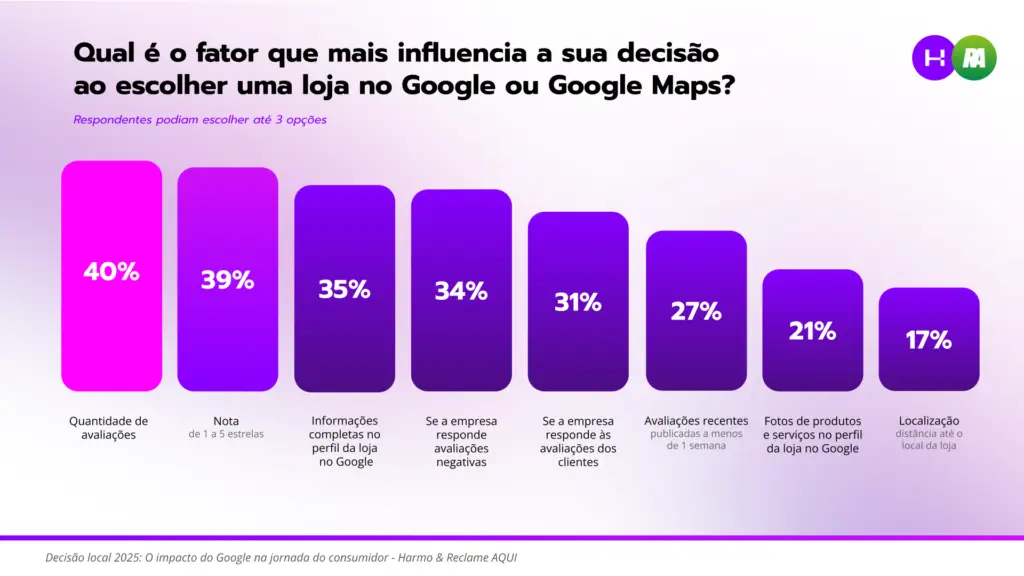
High ratings and a large number of reviews indicate which stores are the best, in the opinion of their own customers. Stores that do not have sufficient social proof are discarded, and only the best continue in the selection process.
A PwC study indicates that 73% of consumers consider experience the deciding factor when choosing a brand – often even above price ($) or convenience.
Reputation is more important than location
Between 2022 and 2025, the importance of location dropped drastically when choosing a store.
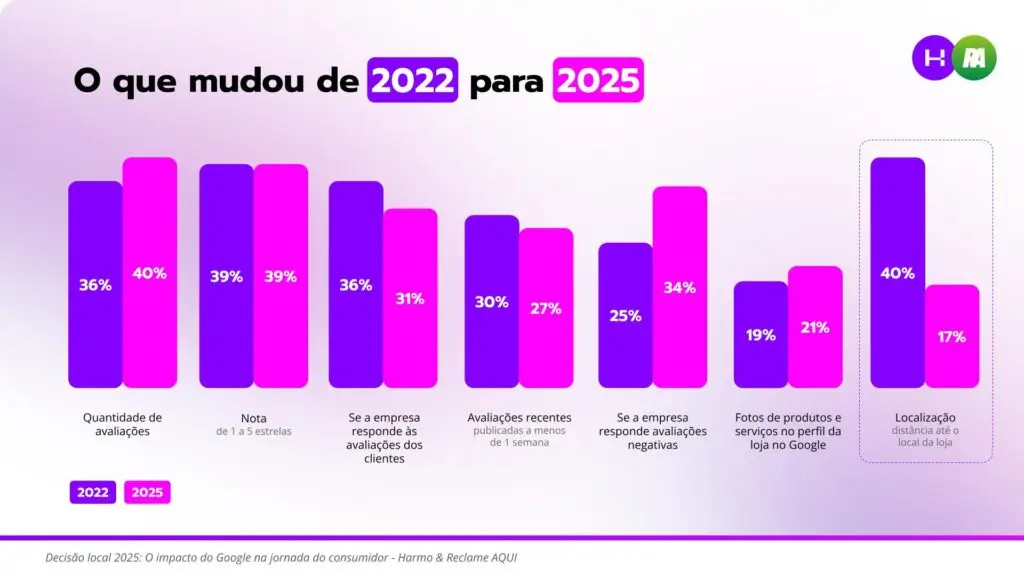
In 2022, 40% of consumers considered location the most important factor when choosing a store, but that number fell to just 17% in 2025, placing it last among all factors analyzed.
In 2025, we also observed that the quantity of reviews surpassed the importance of the rating, which remains very relevant, but only when accompanied by a number of reviews that inspire confidence. A high rating with a low number of reviews does not help attract customers.
The factor that grew most in importance from 2022 to 2025 is whether the company responds to negative reviews, increasing from 25% to 34%.
This means that, before choosing a store, the consumer wants to know how they will be treated by the companyin case they have a negative experience.
This shows that consumers are willing to go to a more distant location as long as the experience is better. In other words, consumers seek experience, regardless of location.
Do you read customer reviews before choosing a store?
Before choosing a store, 96% of consumers read reviews on Google, making the voice of the customer a decisive factor in the buying journey.
The vast majority, 70%, read both positive and negative reviews to form their opinion about the store. Another 13% of respondents read mainly positive reviews and 13% read mainly negative reviews.
Reviews shared on Google exert a great influence on the choice of a store and have become an essential part of the journey that takes the consumer from online to the physical store.
Consumers want to know what customers are praising, the highlights of their experience, and how the company treated customers who had a negative experience.
According to Edelman, 81% of consumers only buy from a brand when they trust it. These reviews serve precisely that purpose: to help consumers decide which store they can trust most.
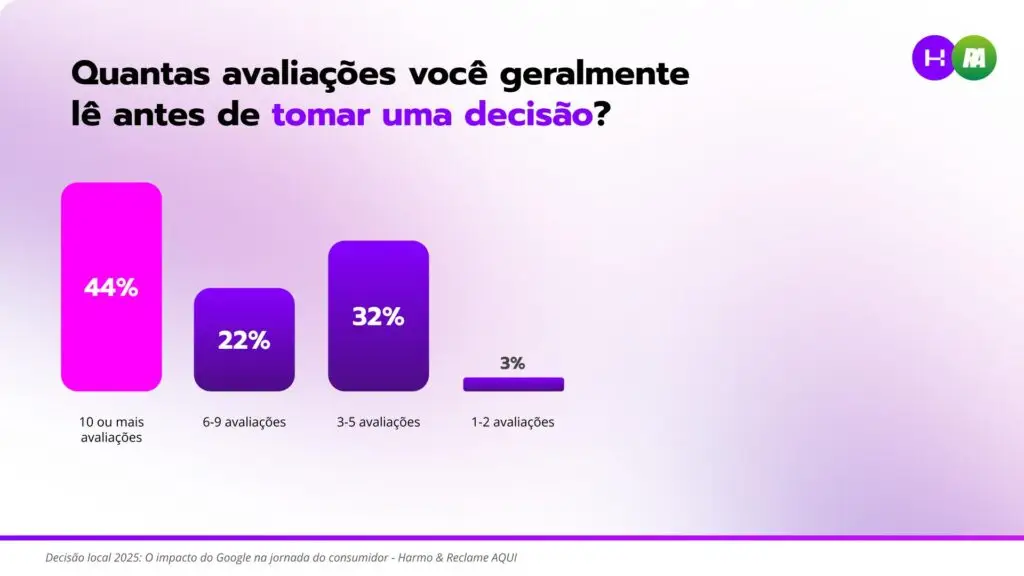
How many reviews do you usually read before making an online purchase decision?
Consumers are discerning when choosing a store
To ensure they are making the right decision, 44% of consumers read 10 or more reviews before choosing a store. And, as we saw earlier, consumers read both positive and negative reviews, demonstrating that they are very discerning.
This reinforces the need for stores to earn reviews daily, as consumers will prefer stores that allow themselves to be analyzed more thoroughly.
Of the 96% of consumers who read reviews, only 3% read 1 to 2 before choosing a store. Another 32% read 3 to 5 reviews and 22% read 6 to 9 reviews.
Considering that, for 27% of consumers, one of the 3 most important factors in choosing a store is related to the date of reviews, which cannot be more than one week old from the date of publication, we arrive at the following conclusion:
For businesses, this data reinforces Google My Business as a strategic customer acquisition channel. The greater the number of reviews, the greater the consumer trust and, consequently, the conversion rate. Active review management – encouraging feedback, responding to interactions, and ensuring a continuous flow of new reviews – becomes an important competitive advantage.
The store that receives more reviews, regularly and frequently, increases the likelihood of being chosen by the consumer.
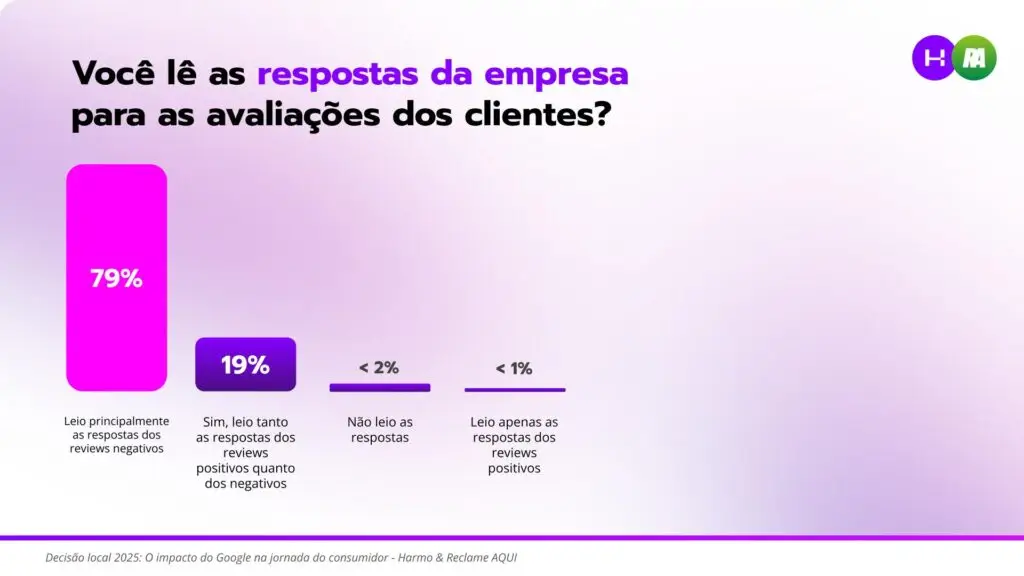
Do you read the company's responses to customer reviews?
Consumers not only read reviews before choosing a store, but they also consider, in their analysis, the responses these companies provide to their customers.
The vast majority, 79%, primarily read responses to negative reviews, which makes perfect sense, since this is precisely the factor that has grown most in relevance from 2022 to 2025 when choosing a store.
Consumers know that companies are not infallible and that problems can occur. But when they do, consumers want to know how the company will treat them. This fact greatly increases the importance not only of responding, but also of how to respond.
On the other hand, companies that don't respond to reviews on Google lose relevance and customers to the companies that do respond.
45% According to research by Review Trackers, a significant portion of consumers prefer to buy from companies that respond to negative reviews.
Responding to reviews is a major challenge for companies and, at the same time, an excellent opportunity to show how much they care about and pay attention to their customers' opinions.
Do companies' responses to customer reviews influence your decision?
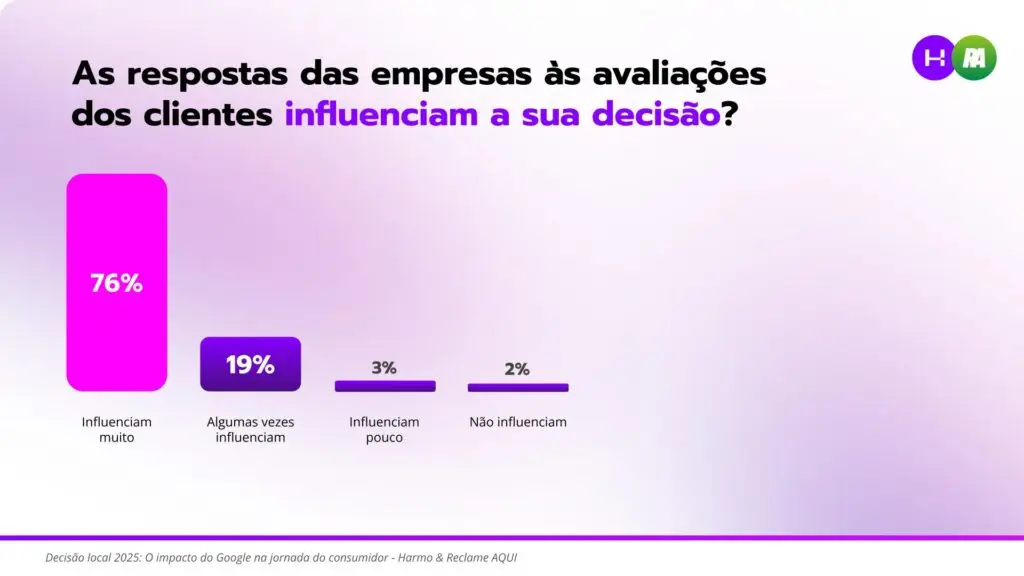
In addition to responding to reviews, companies need to consider the quality of their responses, as for 76% of consumers, company responses greatly influence their choice of store.
Consumers are opting for companies that interact with and thank their customers for the reviews they receive, whether positive or negative, with only 2% of consumers not being influenced by company responses.
It's crucial to consider that thousands of consumers will read company responses every day, directly influencing their choices. Therefore, responses shouldn't just be for the customer who submitted the review, but for the thousands of potential customers who will read the response before making a decision.
The more personalized the response, the more confidence consumers will have in a store. A poorly crafted response can cause significant damage and drive away thousands of potential customers.
What is the lowest rating a company can have to be considered trustworthy?
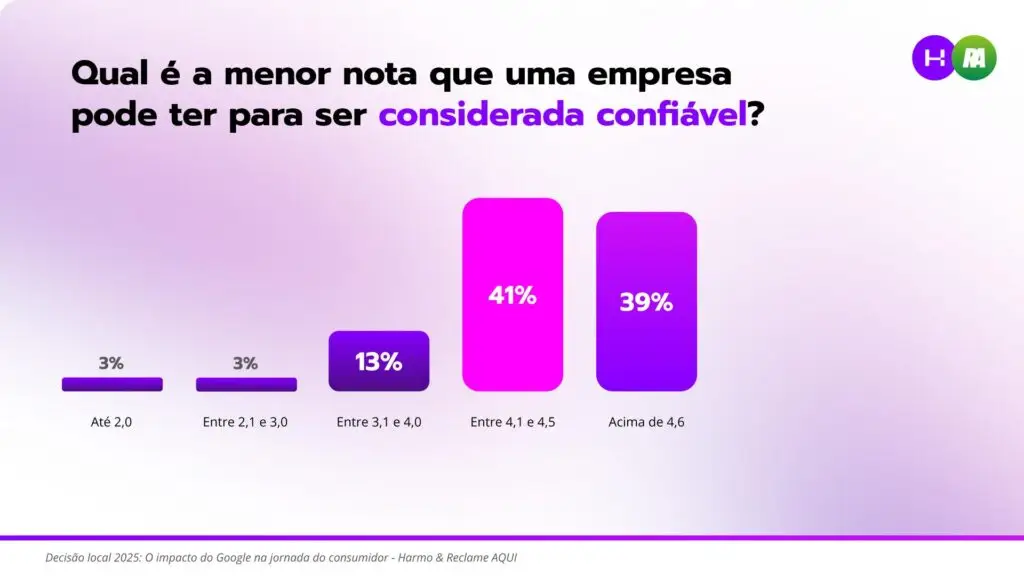
The rating is the second most important factor in choosing a store, second only to the number of reviews.
For 41% of consumers, the minimum rating a store can have on Google is 4.1 stars. Below that, it will hardly be considered as an option, let alone be chosen.
But for 39% of consumers, the minimum rating needs to be 4.6 stars, a really high score that demands extra attention from companies in managing their reputation on Google.
With so many options when choosing a store, consumers avoid stores with ratings below 4 stars. A negative reputation on Google is a major obstacle to attracting customers from online to offline.
87% According to research by Brightlocal, a significant percentage of people did not consider choosing and buying from a store with less than 3 stars.
Have you ever decided against choosing a store after reading negative reviews about it on Google?
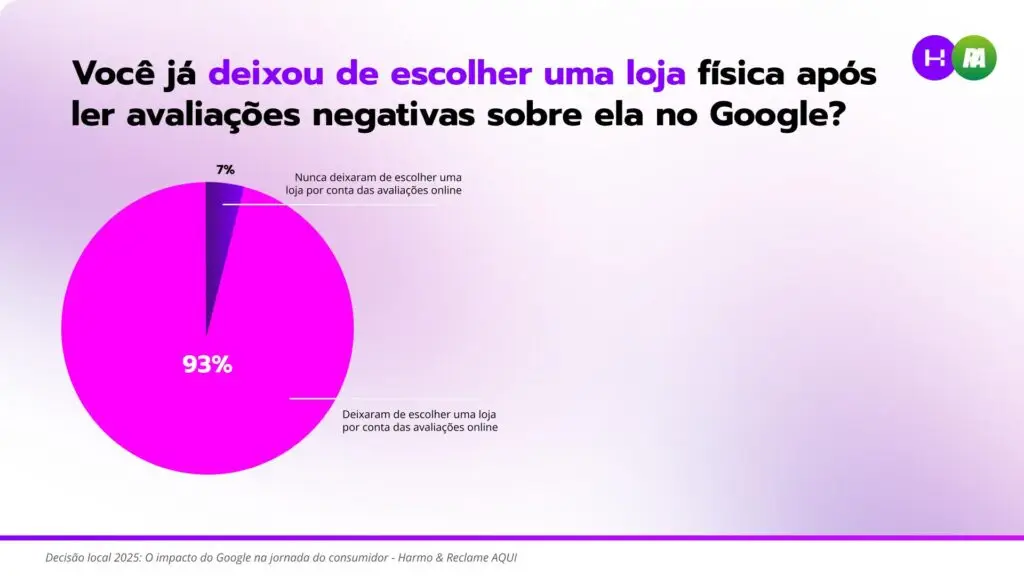
93% of consumers have stopped going to a store after reading negative reviews about it on Google, reinforcing the importance of online reputation management as a customer acquisition strategy.
Considering that 76% of consumers surveyed confirmed that companies' responses influence their decisions when choosing a store, we offer this point for reflection: the power of a well-crafted response to a negative review.
To choose a store, consumers need to answer the following question in their minds: which one inspires the most confidence in me? The answer comes from the stores' own customers, who share their experiences publicly through reviews.
In a survey conducted by Review Trackers, the answer to this same question yielded virtually the same result: 94% of consumers stated that they had stopped choosing a store after reading negative reviews about it.
Do you rate businesses on Google?
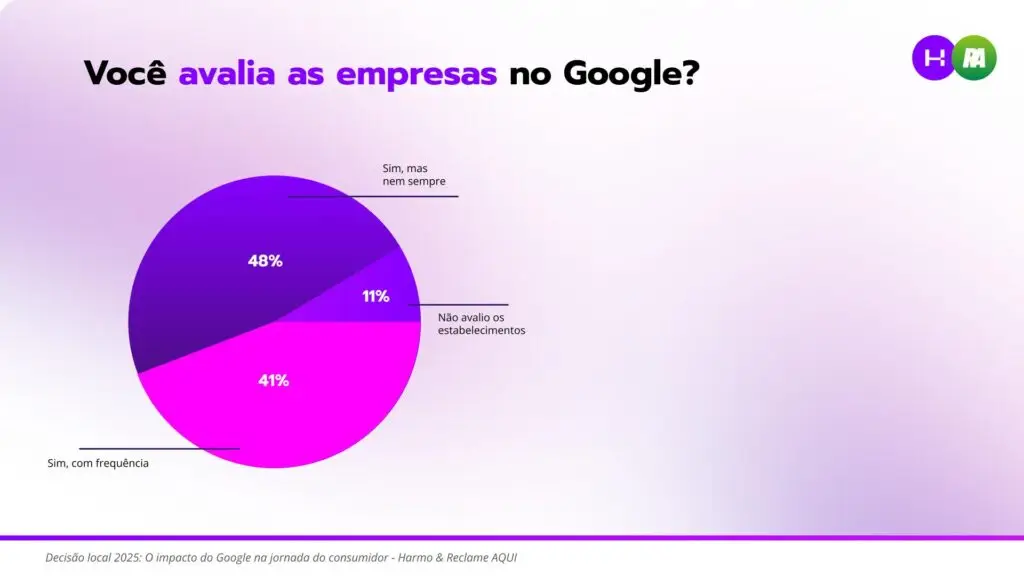
Consumers have discovered that they can help each other make better purchasing decisions and have come to trust the reviews they share daily on Google.
This makes reviews extremely relevant in the buying journey, so much so that 41% of respondents say they review companies frequently , and another 48% review them, but not always. Only 11% of respondents said they do not leave reviews.
However, let's remember that when choosing a store, 97% of those surveyed say they read Google reviews to decide which store they will visit and spend their money on.
Therefore, to sell more, companies depend on customer reviews. Without reviews, consumers cannot know if the company will meet their expectations or if they can trust it. So they will look for another company until they find one they feel more secure choosing.
Why do you consider it important to rate a company on Google?
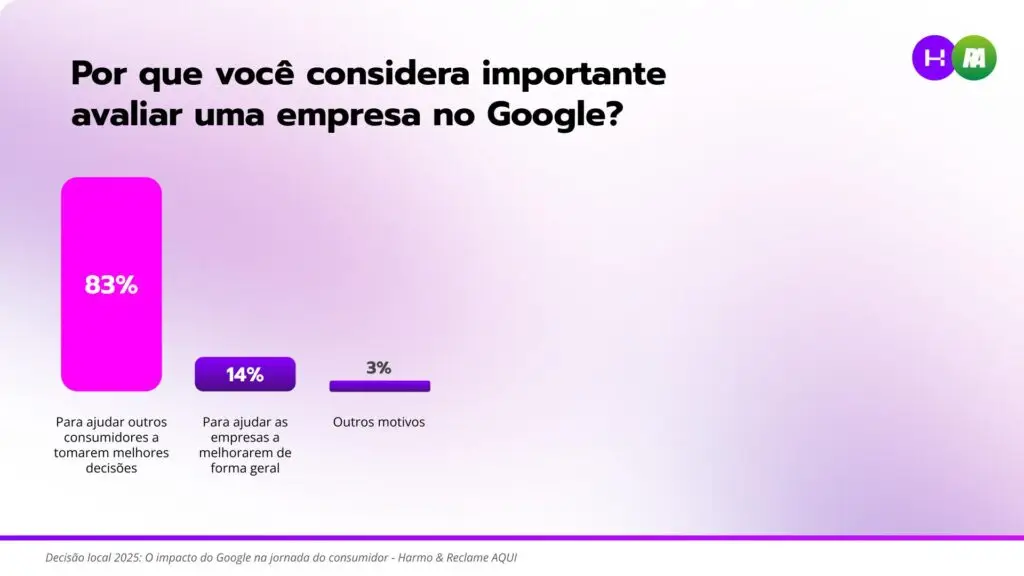
This question is probably the most important in the research, as it reveals the true intention of the consumer when evaluating a store on Google: to help other consumers make better decisions.
That's the goal for which 83% of customers rate companies on Google. Consumers want to know, directly from the companies' customers, whether or not they can trust them, whether or not they will have a good experience, and whether or not their expectations will be met.
Only 14% of consumers rate companies to help them improve. In other words, when consumers rate a company, they are not talking to the company itself, but rather amongst themselves.
Consumers have created a constant cycle where the current customer directly influences the decision of the future customer.
This is why many companies respond to reviews incorrectly, because they think customers are talking to them, but in reality, they are not. And that changes everything.
When you evaluate companies, what is your most common approach?

The survey data definitively debunks the myth that customers prefer to complain more than praise when rating companies on Google, as 62% of consumers responded that they rate companies both positively and negatively, depending entirely on the service they received.
Another 34% tend to recommend more than criticize , and only 4% tend to criticize more than recommend.
Companies that provide good customer service don't need to be afraid to ask for reviews. However, they should never offer discounts or perks to receive positive reviews. Providing excellent service is the secret and the only way to achieve this.
Companies also don't need to fear negative reviews. On the contrary, a negative review is an opportunity for the company to participate in the conversation and demonstrate how it treats its customers, through a sincere response that aligns with the goal of reviews: to help consumers make better decisions.
Companies that provide good customer service don't need to be afraid to ask for reviews. But be careful, never offer discounts or perks in exchange for positive reviews. Always comply with Google's policies to avoid problems.
In which business segments are reviews a determining factor in your choice?
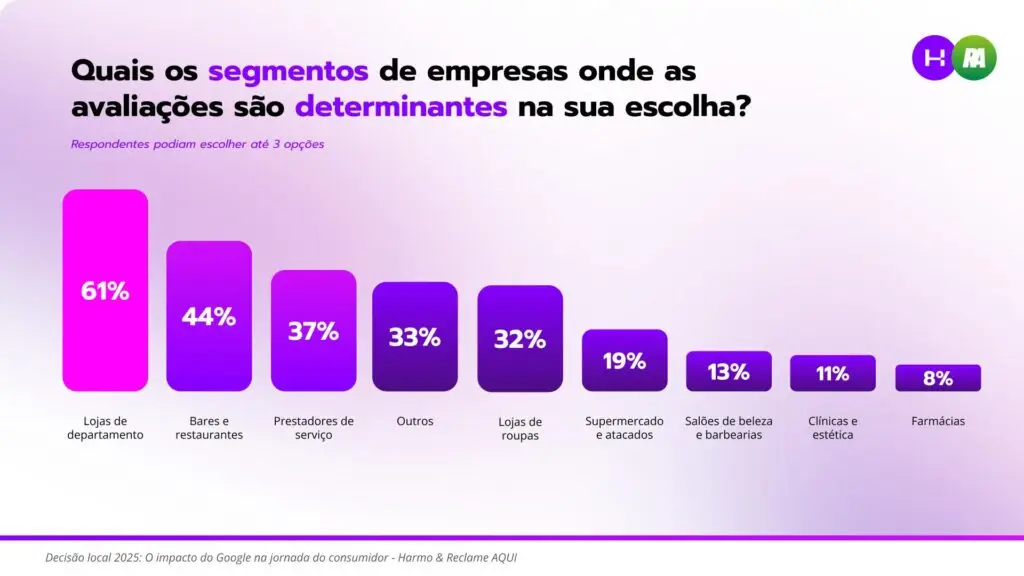
Department stores are the segment where reviews are the most decisive factor in choosing a store, according to 61% of the more than 1,500 consumers who responded to the survey.
In fact, this segment receives a very high number of reviews, and it's normal to find stores with more than 3,000-4,000 reviews on Google.
44% of consumers understand that reviews of bars and restaurants are essential for making their choice.
For 37% of respondents, service providers are among the three segments where reviews exert a great influence on their decisions, followed by clothing stores, with 32%, a surprising result, given that this segment does not usually receive many reviews from its customers.
Pharmacies came in last place, with 8% of respondents selecting this segment among the three that most rely on reviews when choosing a store. In this specific segment, reviews tend to be more negative than positive, and the quantity is generally low, which opens an opportunity for companies in this segment to perform better with Google My Business, standing out from the competition, one of the fiercest in the market.
About Harmo:
Harmo is the leading platform for managing Google Business Profiles in Brazil. Helping over 40,000 points of sale increase customer traffic from online to offline in their physical stores .
About Reclame AQUI:
Reclame AQUI is the largest reputation platform in Brazil. Connecting consumers and brands for a more transparent relationship, the platform influences purchasing decisions, helping companies improve their customer service and customers make safer choices.