
How do you find out what your customers really want or expect from your company? What happens when you offer the best product or service and they still buy from your competitors? The truth is that the answer (and solution) lies in mapping and understanding the customer journey.
With this tool, you create a visual representation of each experience your customers have with your company, from initial engagement to a closing stage.
To create an effective customer journey, it's essential to see things from the customer's perspective and take the same steps they do to deeply understand their challenges.
Without further ado, let's understand what a customer journey is, and why you need to create yours.
What is the customer journey?
The customer journey is a tool used by managers to understand the steps their customers go through to achieve a goal with their product or service. Mapping this journey helps companies put themselves in the customer's shoes and see the business from the customer's point of view.
Furthermore, this tool helps companies gain insights into customer pain points, how they can improve this experience, and define what customers need to achieve this goal.
Another essential factor is to make it practical, simple, and visual. In other words, you can set aside details that are exceptions at first and focus on the clearest patterns of behavior to act on them efficiently.
It's also important to remember that the customer journey should not be confused with the company's internal processes.
The focus of the activity is to understand the steps the client takes with your company, and not how your employee should act or behave in this situation.
What do I need to know before mapping the customer journey?
A customer journey map takes many forms, but it typically appears as some type of infographic for easy visualization.
Furthermore, the map focuses on telling the user's story, from the motivation that led them to find your product, their first contact with it, the trial period, feedback collection, and what encourages them to continue using and paying for the service or product you offer.
As you can imagine, this story may have longer and more delicate stages than others – which is why it's so important to understand it completely. Whatever form it takes, the goal is the same: to bring clarity to your team about your customers' experiences.
Essentially, the customer journey should be:
- Simple and visual;
- Functional;
- Have up to 15 steps;
- To tell a story;
- Approved and developed by different departments of the company;
- To have a beginning, middle, and end;
In other words, each stage of the customer/company relationship should be tracked and documented in a user experience management plan .
This allows companies to understand customer behavior and predict their actions even before acquiring leads and future customers.
What is the purpose of the customer journey?
Journey mapping helps you and your team put yourselves in the customer's shoes and understand how you position yourself in relation to your customer, from their point of view. After mapping the journey, you will be able to identify:
- Valuable insights into the touchpoints you have with your customer – highlighting those that require the most attention;
- Potential gaps in your current operation;
- How your customer interacts with your company;
- Variations in the sentiment curve (expectation vs. reality);
- Opportunities and pain points.
This allows you to improve your customer experience and identify the most and least difficult steps they face when using your product or service.
In other words, with the customer journey map in hand, you and your team will:
- Pay attention to how and where your customers interact with your brand;
- Focus the business on the specific needs of the customer at different stages of the sales funnel;
- To understand if the customer journey is following a logical order and without deviations;
- Gain an external perspective on your sales process;
- To see the gaps between expectation and reality;
- Understanding development and improvement priorities;
- Focus your efforts on what is most important to your client.
The 4 stages of the customer journey buying process
Understanding what your customer feels or expects from your brand is fundamental for your company to be able to offer them something personalized and that makes sense according to each stage of their customer journey's decision-making process. Check out the 4 stages of the customer journey's buying process:
#1 Learning and discovery
In this first stage of the journey, your potential customer is not yet aware of the problem, so it is unlikely that they will be looking for solutions at this time.
In the discovery phase, it's not the ideal time to talk about your brand or product, but rather to educate your potential customer about the benefits and advantages your product line offers. At this stage, it's time to showcase your brand's value proposition and how you can help this potential customer make the best decision.
#2 Decision Consideration
In the consideration stage, your potential client already knows they have a problem, and their focus is on understanding that problem in its entirety and finding ways to solve it.
But your potential client isn't yet at the buying stage; they're focused on how to solve their problem. The best thing to do at this stage is to address the various questions they likely have. In other words, the focus of your actions remains education.
#3 Purchase decision
Your potential client has already come a long way, learned a lot from the materials you provided, and has certainly already formed an opinion of your company.
Note that up to this stage, your brand is gaining recognition in the market, your business has established authority, and your audience is engaged.
So now is the time to reveal the details of your product or service and make it clear to this potential client why your solution is better for them.
📌Check out our article: What is the feedback economy and what has changed in your customer's buying journey?
#4 Loyalty
Your potential client chose your company and closed the sale. Mission accomplished, right? Not yet.
If your brand has remained attentive and present throughout the entire customer journey, the biggest mistake you could make is simply disappearing after the purchase. This attitude not only breeds distrust but also wastes all the relationship work built previously.
When customers become loyal, they can turn into great advocates and promoters of your brand – a fundamental strategy for your company to remain competitive for many years.
📌Read our article: Customer Journey: Learn about the 4 stages of decisions
What are the steps to map the customer journey?
Are you ready to start mapping your users' journey? Like any other strategy or action plan, it requires planning.
#1 Define the stages
The first step in creating a customer journey is to align the goals and stages you want to understand. At this stage, it's important to ask yourself some questions such as:
- What is the main challenge I currently face with my clients?
- What do I want to identify when mapping my customer journey?
- What is my goal in understanding my customer's journey?
These questions will give you greater clarity about the journey, and prevent you from wasting time looking at one or more less important parts of the process.
#2 Select your points of contact
Touchpoints are all the channels through which your customers interact with your company. Therefore, at this stage you should list all the touchpoints through which your customers reach you.
This is an important step in creating a customer journey map, as it provides information about your customer's interactions with you. In the online environment, some of the first interactions are typically through:
- Social media;
- Public review and feedback sites;
- Your own website;
- Chat;
- Email; and
- Telephone
A good tip is to do a Google search for your brand to see all the pages that mention you. It's also important to have a close relationship with your Google Analytics – through it, you can identify where a large portion of your website visitors come from.
After becoming your customer, the points of contact can be different, such as:
- FAQ page;
- Skype;
- Chat;
- Your app (if you have one); and
- Representative.
#3 Map the journey (finally)
The time has come to put everything you know about your customer journey on paper! A good tip to make your journey even richer is to bring together different departments of the company to get a 360-degree view of what the customer expects versus what the customer receives.
It is recommended that the journey be structured in columns, so at each stage, include the touchpoint, what the customer expects, what they receive, and the sentiment curve. There are some questions regarding the sentiment curve stage, but you basically need to align how the customer feels after that stage. To make it clear, here are some examples that might leave your customer dissatisfied:
- Does this step require a lot of effort?
- Are the customer's expectations too high for what they are receiving?
- Is what he receives what he expects?
These are just a few examples that might leave your customer dissatisfied after a certain stage. And as I said before, there's no right or wrong way to create a customer journey map; the fields are fully customizable to suit your business.
Typically, the end result will be some form of infographic with a timeline of the user experience. But start with a team brainstorming session and sketch everything out on a whiteboard or stick post-it notes on a large sheet of paper.
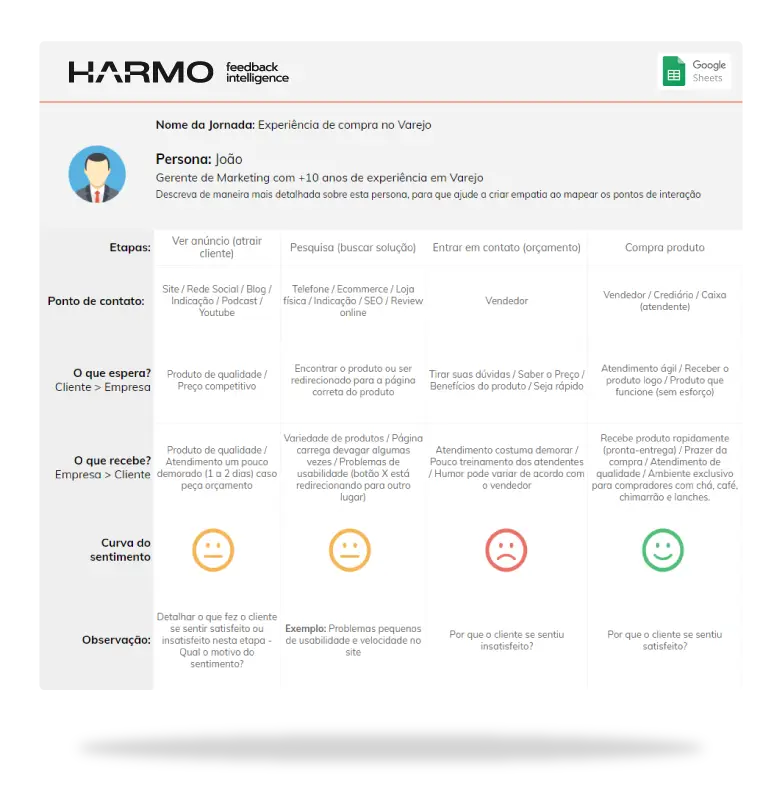
#4 Custom Fields
Since the customer journey is a flexible tool, it can contain additional fields depending on your company. We've included some examples that are commonly used in customer journeys.
#5 Turn insights into action!
After mapping your customers' journey, it's common for various ideas for new projects and improvements to emerge. To help you carry out all the necessary actions, I suggest a simple prioritization method:
- Select the area that needs improvement as a priority – this will be your initial focus;
- Break this action down into smaller activities;
- Determine who is responsible for each activity;
- Set a deadline for implementing these improvements;
- Implement the action within the deadline and move on to the next priority action.
It seems basic, but selecting one improvement action at a time is one of the best ways to avoid getting lost in a sea of demands.
Above all, remember that the customer journey is not a finished product, but rather a tool to help you understand and improve your customer and user experience.
As I mentioned before, it's important to keep in mind that the customer journey doesn't end after the purchase.
Your customers can share opinions and reviews about your company or product on specialized websites and communities. This requires close monitoring of social media, but the effort is worthwhile since user feedback is invaluable to the company.
Check out our article "The Buyer's Journey and Customer Attraction: 3 Fundamental Principles for Success".
3 Examples of customer journeys
Still have questions about how to create a customer journey? Then check out the following examples of companies that use this strategy in their business:
Yahoo's Customer Journey:
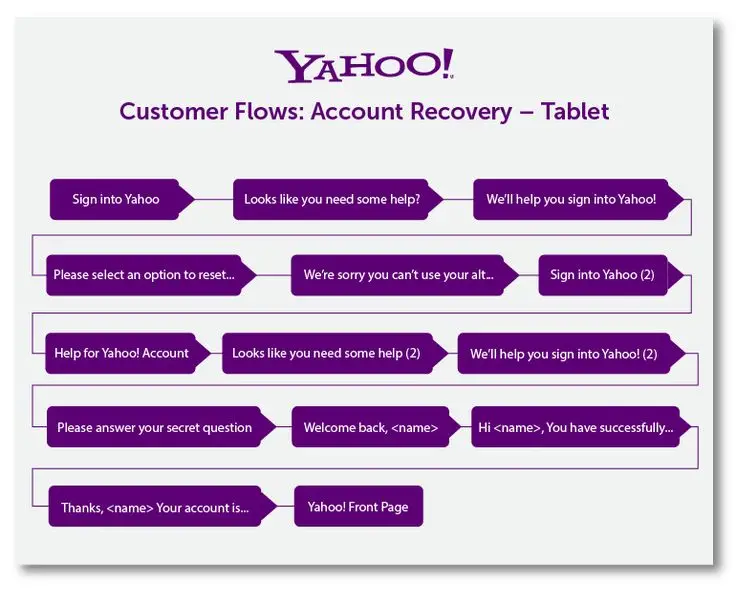
Yahoo's customer journey map is structured more like a flowchart, making it easy to track customer progress. With extreme simplicity, they detail the customer's journey to account recovery. The process is very easy and visual.
Did you like this example from Yahoo? There's more!
Starbucks Customer Journey:
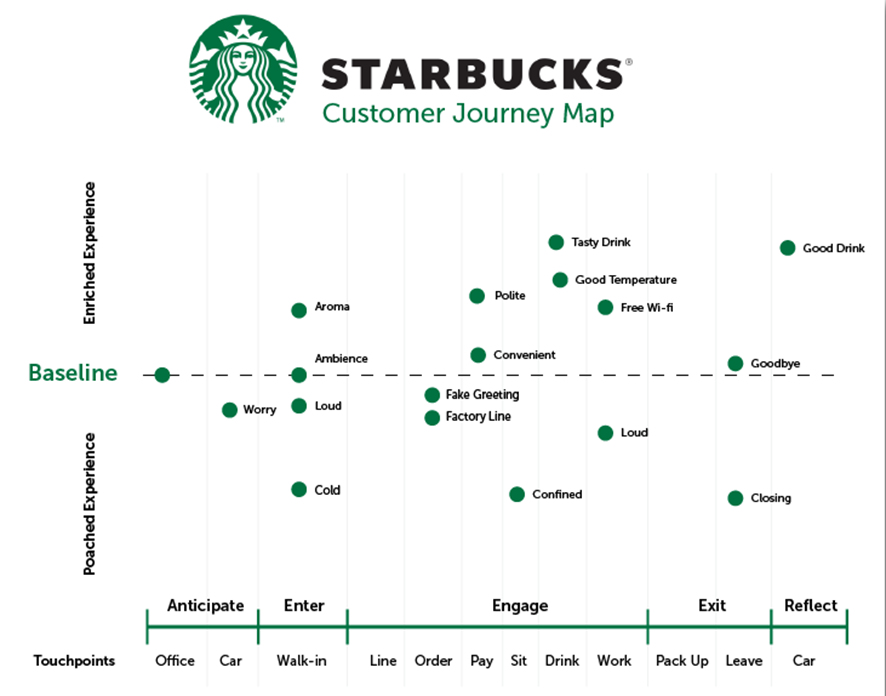
Starbucks' customer journey map follows a timeline layout, mapping everything from the user's arrival to their departure from the establishment. Furthermore, it's possible to understand the customer's expectations and feelings at each stage.
Deepening the Customer Journey
Of course, this topic comes up frequently here at Harmo. We always receive questions about the Customer Journey, and we also delve into some more specific details.
To help you better understand how all this works, we invited Monise Tonoli, Customer Experience Manager at Peixe Urbano, to talk a little about her own experience measuring, gaining insights, and creating actions based on the Customer Journey in an interactive webinar!
📌[Webinar – Immediate Access]: Simplifying the Customer Journey
Webinar topics:
- What is the Customer Journey and what is it for?
- What it should look like visually;
- How to share the Journey with the company;
- Relating the Journey to the NPS;
- How to break down the workday into team tasks;
- How long does a Customer Journey last?
- Practical tips on the Customer Journey;
- And much more!
📌[Webinar – Immediate Access]: The Customer Journey in 2021: How to plan to deliver what customers need and want in the post-pandemic era?
Webinar topics:
- How to plan for the start of a new year and not be caught unprepared;
- Remapping the new journey (persona and new consumer behaviors);
- What are the most critical aspects of this new journey that require closer attention?
- Rethinking how to relate to the "new" customer;
- Global market data and upcoming trends in CX for 2021;
- And much more!
How to measure customer experience through their journey
This is a delicate stage and depends heavily on your objective for the customer journey. It's the right time to launch a survey to measure and track the Customer Journey indicators.
To ensure you subtly capture the best customer information, it's essential to apply your existing knowledge of customer profiles when creating your survey. But what type of survey should you use to obtain these indicators? Here are the most commonly used:
Net Promoter Score (NPS)
NPS , or Net Promoter Score, is a customer loyalty metric. Its goal is to determine a consistent and easily interpretable score that can be compared over time or across different industries.
This metric is suitable for evaluating customer loyalty after a customer journey, not over short periods of time.
If you're looking to measure the steps more frequently, NPS isn't the best option. In that case, it's advisable to use CES or CSAT, depending on your objective.
Customer Effort Score (CES)
Customer Effort Score is a metric used to measure the level of effort a customer had to put into resolving a specific problem with your company.
In addition to being the most predictive metric when it comes to customer experience, it is also suitable for transactional research, that is, research conducted at shorter intervals.
Therefore, it can be applied after each stage of their journey, if your goal is to discover the customer's effort to perform an action with your company.
The faster a customer can resolve their problem, the better you are doing and the greater your customer satisfaction!
But the truth is, the coolest part is being able to use this tool to identify the details that can be improved within the Customer Journey.
For example, if the effort level is high: it indicates a process gap or a point in the journey where the customer simply doesn't know where to go.
You can recognize this issue and take corrective action to improve the relationship with the client. There's always room for improvement, so identifying it is a very strong point in your favor!
Customer Satisfaction Score (CSAT)
The Customer Satisfaction Score is a metric that directly measures customer satisfaction levels in specific interactions with your company.
This is also a transactional metric, allowing you to measure each stage of the journey if your goal is to discover customer satisfaction levels.
Which metric should I use to map the customer journey?
Before concluding our thoughts, the intention is for you to understand the best time to apply the correct metric. For example, NPS is not suitable for short periods of time; in that case, there are other metrics such as CES and CSAT.
Therefore, choosing one research study at a time and timing it correctly is crucial. Only by sensibly selecting the right research to measure what you want will you be able to find the insights you seek!
Check out our webinar! Measuring customer experience: the 4 main metrics and which one to use for each stage of the journey.
Conclusion
The customer journey is an incredibly powerful tool for businesses. Besides being a very healthy practice for the company, it allows you to identify gaps in operations that can be easily corrected before they reach the customers.
To gain a 360-degree view of your customer, it's recommended to practice this with different departments within the company, integrating teams and collaboratively seeking solutions for the benefit of the consumer.
Therefore, remember, the goal of the map is to visually represent the entire journey a customer takes with your company, showing a beginning, middle, and end.
Another very important point before concluding this topic is that you validate the journey with a real customer. It's pointless to create various hypotheses and assume that's exactly what the customer does, isn't it?
Therefore, the customer journey should be as close to reality as possible, with minimal guesswork.
And to validate the journey, it's helpful to monitor the levels of expectation/delivery from your customers; this way, you can identify their feelings and objectives with your company.
Interested in mapping and improving your customer experience? Meet Harmo – the first and only platform that integrates online reputation management with NPS®, CES, and CSAT surveys.