
One of the most important characteristics that a company must preserve is its relationship with the customer.
The customer is a vital part of the business, and it's essential that they feel motivated and happy with their experiences interacting with brands.
In such a competitive market with so many options, those businesses that treat their customers in a differentiated way and value good relationships come out ahead .
How have you been managing your customer relationships? Discover in our post the importance of this topic and how you can measure this investment in your company!
What is customer relationship management?
When we talk about creating bonds and relationships, it's not about invading the customer's space too much in search of a place in their memory. Such an experience can, in fact, have the opposite effect and be negative for the consumer.
Maintaining a relationship with a customer goes beyond the traditional sale, anticipating their needs, ensuring positive experiences, and delivering real value. Put that way, it sounds simple, doesn't it?
But by getting to know and interacting with the customer, it's possible to understand them better, know what they're looking for, and when it's important to offer new products or services.
Furthermore, it's possible to offer personalized treatments and treat each one as if they were the most important client.
Of course, as you acquire more customers, it can become more difficult to get to know them all and please them individually. That's why it's important to have successful customer teamsthat are attentive to this crucial part of the business.
It is also valid and relevant to have CRM strategies, which help map customer interactions, searches, and profiles, making it easier to manage demands.
Investing in customer relationships increases company trust, both for consumers and the market, as well as building loyalty and making it easier to identify and resolve customer problems, reducing losses and frustrations.
Loyal customers, in addition to returning to your business, spread the word about your establishment and attract new consumers to learn about it.
How do you measure customer relationships?
Many companies understand the good reasons for creating initiatives, building teams, and investing in customer relationships, but they have doubts about how to measure the results of their investments, right?
Therefore, it is important to pay attention to certain metrics that can quantify behaviors and trends, allowing you to measure and evaluate the actions taken by the company.
By using good information, it's possible to make more strategic decisions based on real numbers and facts experienced in the business. We've selected some metrics that are important to measure and that you can put into practice right now!
Customer Acquisition Cost – CAC
Customer Acquisition Cost shows how much a business invests to acquire each new customer.
This metric encompasses the entire customer journey, from attraction and lead to closing the sale—all the important phases in the customer relationship.
To calculate CAC, simply divide the total investment required to acquire a customer by the number of customers acquired in a given period, that is, CAC = Total investment / Number of customers acquired.
The total investment should include expenses directly involved in customer acquisition, such as salaries for the responsible teams, tools used, advertising, software, events, phone calls, printed materials, and others.
It's important to have a CAC (Customer Acquisition Cost) that is lower than the average ticket price spent by a customer in your store, and also lower than the LTV ( Lifetime Value ), which we will explain in the next section.
Lifetime Value – LTV
LTV, or Lifetime Value, is about how much a customer contributes to your company throughout their lifetime, that is, from their first purchase or contract signing. Lifetime Value is an important metric and should be measured at regular intervals.
Monitoring this number can help with marketing and sales goals and reducing acquisition costs, as well as encouraging a longer-lasting relationship with the customer so that they spend more and increase their engagement with your company.
There are several ways to determine this metric, but the simplest and most basic is to sum a customer's revenue (annual revenue x average customer lifetime) minus the initial cost of acquiring them.
In other words: LTV = Customer Revenue (annual revenue x customer relationship in years) – Customer Acquisition Cost (CAC).
To understand better, let's look at an example.
Let's say a company generates 5,000 reais per customer each year (who stays with them for 10 years) and that its CAC is around 3,000 reais.
The calculation would be: R$ 5,000 x 10 – R$ 3,000 = R$ 47,000.00.
Based on this value, it's possible to devise strategies to extend contract terms and further invest in and enhance customer relationships.
It's important to understand that LTV is not a fixed value, but a metric used to develop strategies, products, and services so that values increase and are updated over time.
NPS – Net Promoter Score
For customer relationship management, this is a very important metric, after all, it measures the customer's recommendation rate after a period established by the company, related to the use of the service or product.
With these results, we can understand whether the customer has the potential to become an evangelist or a detractor of the brand. Furthermore, this metric is gathered through satisfaction surveys.
The NPS question is simple: "On a scale of 0 to 10, how likely are you to recommend us to a friend or colleague?" , followed by an open space for the customer to explain the reason for their score.
From there, the metric divides customers into three categories – promoters (scores of 9 and 10), neutrals (7 and 8), and detractors (0 to 6).
Knowing the categories, it's possible to calculate the company's NPS by subtracting the percentage of detractors from the percentage of promoters:
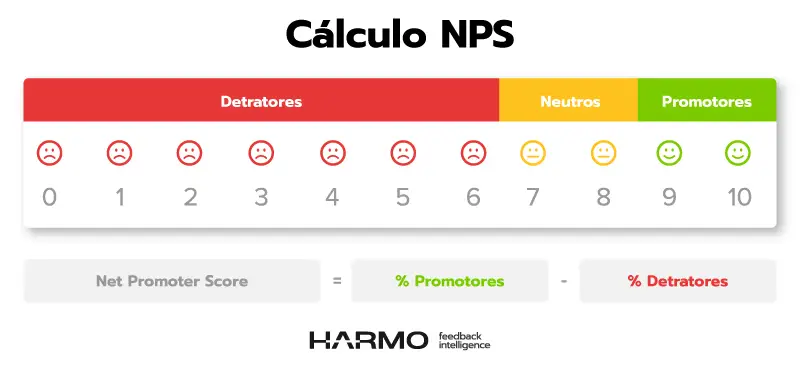
A high NPS score means that customer satisfaction is good. The lower the number, the poorer the customer experience and relationship with your brand has been.
Churn rate
Churn rate period is the number of customers who abandon or cancel products or services within a given .
To calculate this rate, simply follow the formula:
Churn = Customers who canceled the service during the period / customers at the beginning of the period x 100.
The cancellation rate allows us to think about new strategies for customer retention and relationship building.
5 customer relationship tips to improve your results
Customer relationship management is one of the most important strategies for any company that wants to succeed. A good customer relationship can lead to increased sales, customer loyalty, and the generation of new business.
Tip 1: Know your customer
The first tip for a good customer relationship is to know your customer. Understand their needs, their desires, and their expectations. The more you know about your customer, the easier it will be to serve them and exceed their expectations.
To get to know your customer, you can conduct satisfaction surveys, analyze sales and service data, and talk to your customers directly.
Tip 2: Be consistent
Customer relationship management is an ongoing process. It's important to be consistent in your actions and your messaging. If you promise something to the customer, keep your promise. If you change something, communicate it to the customer.
Consistency builds trust and credibility.
Tip 3: Be proactive
Don't wait for the customer to come to you with a problem. Be proactive and try to solve problems before they happen.
You can do this by offering personalized service, providing useful information, and developing efficient service processes.
Tip 4: Offer value
It's not enough to simply meet customer needs. You need to offer value to the customer. Value can be offered in various ways, such as high-quality products and services, competitive prices, and excellent customer service.
Tip 5: Use technology to your advantage
Technology can be an important ally in customer relationship management. You can use technology to automate tasks, collect data, and personalize customer service.
Conclusion
Investing in customer relationships is extremely important for businesses, building trust and making companies more competitive.
Having customers on your side ensures they will return, become loyal, and, more importantly, speak positively about the business, spreading the word about the company's profile.
Customer opinions are very important, especially in a scenario where everything is easily found and spread through social media.
Knowing how to listen, deliver value, and solve problems quickly and effectively strengthens customer relationships , and results will certainly come faster.
More than just investing in relationships, it's essential to always examine strategies and measure each action. Metrics are allies for entrepreneurs, helping them understand what's working and what needs to be changed quickly.
Rely on numbers and formulas, which offer new directions and perspectives for business growth, and start making changes right now.
What have you been doing about your customer relationships? Now that you know more about the topic, take advantage of our solutions that will help you improve your customer experiences!