
You've certainly heard of the customer journey and know at least a little about journey , right? More than just understanding the journey and offering good experiences at each interaction, it's increasingly necessary to invest in personalization.
People want their needs met, and making the consumer feel special and remembered by the brand is a major differentiating factor in whether or not your business is chosen.
How has your brand been providing experience for your customers? Let's talk more about customer journey and personalization so your business can stand out even more!
Why is personalization crucial in the customer journey?
Personalizing the customer journey is key to offering increasingly personalized and differentiated experiences, increasing the value of brands with their audience.
Investing in customer experience and personalization isn't just about calling someone by name or remembering their birthday, for example, but rather having comprehensive strategies at every stage of the journey so that each consumer feels remembered and important to the company.
According to the Next in Personalization 2021 report , 71% of consumers expect to have personalized experiences and 76% feel frustrated when this doesn't happen.
According to CX Trends Latam 2022, 90% of customers are willing to spend more on personalized experiences , and companies that personalize experiences generate 40% more revenue.
In other words, investing in experience and personalization is about investing in financial returns and brand benefits for the business, and this topic can no longer be postponed.
When we talk about customization, we're talking about several advantages, such as:
- Generate more qualified leads: by getting to know your customers or potential buyers, understanding their needs, and personalizing their journey, the company starts to have more qualified leads. Personalization generates greater attraction, after all, the communication is directly related to the customer's desire/need, and interest increases, raising the chances of conversion.
- It increases conversion rates: people are willing to invest in companies that value experience, so by creating unique offers and showing the value of your customer to the business, the greater the chance of purchase and, consequently, the increase in conversion rates.
- Word-of-mouth marketing increases: consumers are willing to recommend products, services, and companies they like and value. By having positive experiences with a brand, it's natural that, in addition to customers, the company also gains organic ambassadors. In this way, the business begins to reach other people spontaneously.
- It increases customer satisfaction: by valuing the customer and placing them at the center of the business, the tendency is for them to feel seen and special. The consequence of this is increased satisfaction and loyalty to the company.
The 5 stages of the customer journey
Before we give you practical tips on how to offer personalized experiences at various stages of your customer journey, let's review the 5 stages of this important cycle:
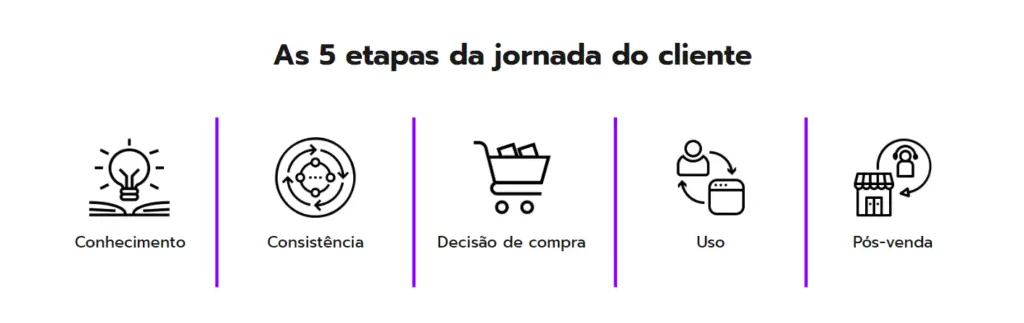
Knowledge
At this stage, the consumer understands that there is a need or a problem to be solved. Therefore, they seek solutions, products, and services, and begin to learn about different brands and options.
Consideration
Now aware of the problem they need to solve, potential buyers seek more detailed information about possible solutions. This is the time to research features, prices, benefits, and brand reputation to assess which options best suit their needs.
Decision and purchase
After analysis and comparison, the customer chooses your product/service and brand to make the purchase. This can be done in a physical store, e-commerce, and many other possible sales channels.
Use
After making a purchase, the customer uses the product or service and forms their own opinion about the brand.
After-sales service
Even after the sale is made by the company, the experience continues, and after-sales service is essential for satisfaction and loyalty. This is the moment when the customer may have questions and may need support regarding the solution.
Good service, support, and follow-up are fundamental to strengthening customer relationships and satisfaction, leading to brand loyalty.
How can you offer personalization at every stage of the customer journey?
Now that we've talked a little about each of the stages, let's discuss them in a practical way. It's important to say, once again, that personalizing the journey goes far beyond calling the person by name or suggesting products based on previous purchases.
Personalization is about truly understanding consumer needs and behaviors in order to offer differentiated and relevant experiences at every stage.
We've gathered some tips to help your business invest in personalization at every stage of interaction with your audience.
Knowledge
As we said, here the customer is still discovering their problem and thinking about how to solve it. Here, content is very important to offer relevant, informative content that answers your audience's questions.
Right now, it's crucial to create personalized content for different types of personas, focusing on the pain points and needs that your products/solutions can solve. The focus here isn't on branding and sales, but rather on being useful and relevant to the audience at the right time.
Furthermore, it's important to invest in targeted social media ads, offering solutions to the personas your business is seeking. Use relevant keywords, create quick and focused content, and always emphasize solving a problem before talking about sales.
Another point is to offer landing pages or customized website pages for different types of campaigns. It's pointless to create numerous targeted ads on your social media if they all lead to the same generic page about your solution. Create different pages that speak to your diverse audiences and use them to present your problem-solving solution in different ways, reaching a variety of people.
Remember that here, being found and relevant is crucial. It's about offering the right content at the right time. Therefore, content, optimization strategies, and relevance are key to the awareness phase.
Consideration
Here, customers are comparing various options, and it's necessary to make it clear why your brand is the best choice. In this case, if it makes sense for your business model, it's a good idea to offer free demonstrations or product trials; after all, nothing is better for the decision-making process than actually knowing the solution before buying it, right?
Content is also a great ally at this stage, and this is the time to talk about the product/solution. Invest in content that answers customer questions and objections, and present your offer in a simple and direct way.
At this point, it's also important to invest in data and behavioral analysis to send personalized recommendations, segmented emails, social media messages, and other forms of communication that initiate relationships and guide the audience toward decision-making.
Furthermore, use social proof as an ally, that is, provide success stories so that the client can see how your company has already helped many other people and businesses, and also provide reviews and feedback from other clients.
More than just leaving this type of content on websites and social media, for example, it's important to invest in strategies like Google My Business. This way, when customers search for your company, they can quickly learn what other customers are saying about their experience and gain insights to make their choice.
Buy
During the purchase phase, it can be beneficial to invest in personalized offers, exclusive discounts, and benefits to ensure the deal is closed under your brand.
More than that, it's necessary to simplify the process so that the customer doesn't give up at this point. To do this, ensure transparency of information, flexible payment options, and secure transactions. Make it possible for the customer to buy with just a few clicks and steps, and remember that the more difficult the process, the greater the chances of them abandoning the purchase.
Another interesting strategy is retargeting, which involves investing in targeting segmented and personalized ads to an audience that has already interacted with the brand but did not complete their purchases.
Use
When a customer makes a purchase and moves on to using your product/solution, it's important to position yourself as a support and ally to ensure the solution successfully meets their needs.
At this stage, it's beneficial to continue providing content with tips and tutorials for the best use of the product or service, as well as always being available for personalized support that addresses the real needs of each client.
Depending on your niche, it may also make sense to create online communities so that customers themselves can interact with each other and learn from one another about uses and ways to get the most out of the solution.
After-sales service
Personalization at this stage plays a fundamental role in customer satisfaction and in determining whether or not they remain with the brand. For this phase, it's crucial to have teams prepared to maintain contact, understand the customer journey and the timing, so that solutions and new products can be offered to meet their needs, even before the customer seeks them out from other companies.
It's also important to offer loyalty and rewards programs so that the customer continues to value the company. In addition, invest in exclusive content and demonstrate that the customer is important to your business.
Another crucial point in this stage of the journey is listening to the customer; that is, seek feedback to understand what was good or bad in the interaction and experience with the brand. Truly listen to the customer, make improvements when negative points are mentioned, and use this moment as a way to grow the business.
The role of technology in delivering a more personalized customer journey
As you've noticed, there are many actions and possibilities at each stage of the journey, and technology is a great ally for personalization at each one:
- Data analysis: technology enables the collection and analysis of customer data, which is crucial for better understanding behavior, preferences, history with the brand, and many other pieces of information relevant to personalization.
- Artificial Intelligence and Machine Learning: increasingly present in business strategies, AI and machine learning can be used to create predictive models that anticipate what a customer is looking for or might like. This can include predicting future purchases, product recommendations, and personalizing offers and promotions.
- Chatbots and virtual assistants: Chatbots can be used to provide personalized, real-time customer support. As a 24/7 solution, they are always available and can answer questions, give recommendations, conduct transactions, and serve as an important point of contact before human assistance is available.
- Marketing and process automation: with automation, it's possible to use user information to create rules for sending personalized content. This makes communication faster, more engaging, and tailored to each audience.
- CRM (Customer Relationship Management): CRM platforms are essential for personalizing the customer experience, as they maintain a detailed record of all interactions with the audience. This allows companies to provide a more personalized and efficient service throughout the customer journey.
Conclusion
Investing in experience and personalization is key to reaching new audiences, building loyalty among those already familiar with your brand, and maintaining long-lasting relationships with customers. Putting the customer at the center is essential for the company's results and goals, and this is a strategy that cannot be postponed.
Knowing your audience, mapping their journey, and understanding how your strategies can be adapted and personalized should be part of your business agenda! Now that you know more about the topic, reflect on your situation, use our tips, and strengthen your interactions with your customers.
How is personalization present in the journey your brand offers your audience? Take advantage of your knowledge on the subject and understand how we can further assist you on this path to personalization!