
What does ZMOT mean?
ZMOT is an acronym for Zero Moment of Truth. ZMOT is a model that explains the discovery and awareness stage of the consumer journey, when they research a product/service/brand before making a purchase decision.
The concept was created by Google in 2011. You can download the book ZMOT: Winning the Zero Moment of Truth, which contains the following definition of ZMOT:
ZMOT is that moment when you pick up your laptop, cell phone, or some other device with internet access and start learning about a product or service that you are thinking about trying or buying.
What has changed in the purchase decision model with ZMOT?
Historically, retailers have worked with a classic 3-stage purchase decision model consisting of a Stimulus, followed by the First Moment of Truth (where the purchase decision is made) and, finally, the Second Moment of Truth (the post-purchase moment, the experience).
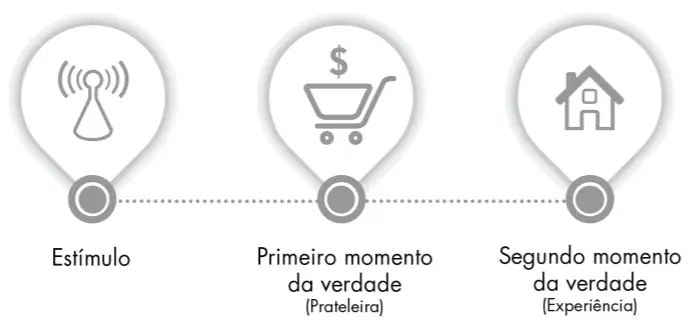
Source: ZMOT: Winning the Zero Moment of Truth
In 2011, Google introduced the Zero Moment of Truth (ZMOT), which describes a revolution in how consumers research information about products and services and make their decisions based on it.
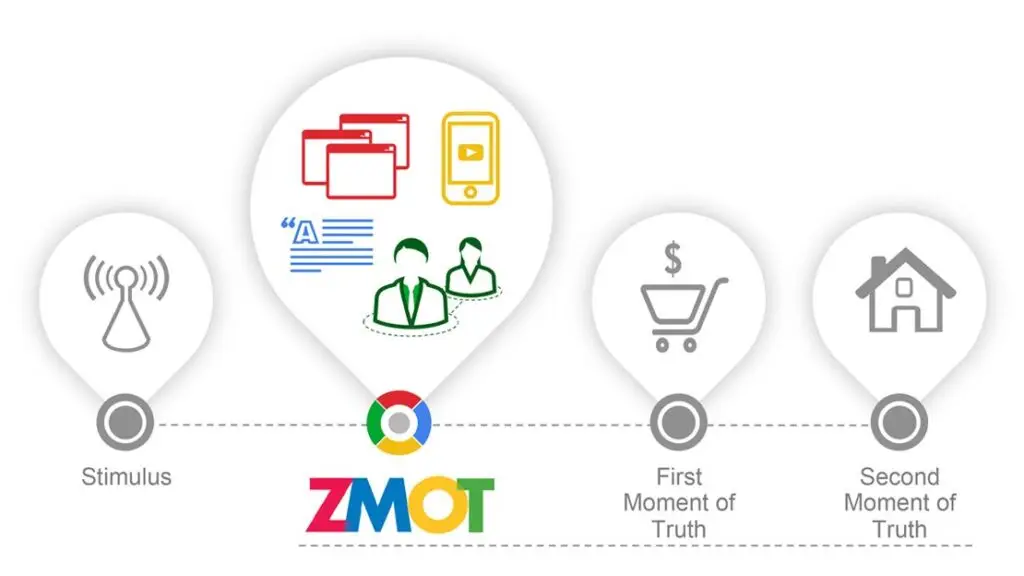
Now, whenever we receive any incentive to try something new, the first thing we do is go online and research the available options and find out what other consumers thought of the experience.
In our digital age, we have abundant and very easy access to information. According to Google, about 60% of shoppers research a product online before making a final purchase decision. Google's analysis also showed that we consulted more than 10 digital sources during ZMOT.
What we see today is consumers making their purchasing decisions in a much more informed way, and this information no longer comes from a single source (the company).
Choices between products, services, and brands are made based on comparison pages, forums, customer ratings, and online reviews. This is the Zero Moment of Truth for companies: depending on the information found, the consumer may stay with or choose the competitor.
How does ZMOT affect my marketing strategy?
One of the biggest impacts that ZMOT has on your marketing strategy is this: it opens up a whole world of possibilities for guiding the consumer to choose your business.
The simple fact that customers are taking the time to research products and services at the Zero Moment of Truth means you have the opportunity to connect with potential customerson a whole new level.
The Zero Moment of Truth proposes that consumers:
- They research the product/service before making a purchase and
- They consult a variety of information sources before making a purchase decision (10 or more!)
If you can connect with your consumers during this stage—at the exact moment when the consumer has a need or desire and seeks help online—and influence their decision in your favor, you will have the potential to sustain a huge advantage over your competitors.
Why ZMOT is relevant for retailers
ZMOT is based on comparing cost-benefit and experience. People use their smartphones to compare prices, look for special discounts, and gauge other customers' satisfaction with the product, service, or brand.
Consumers are looking for answers to questions such as:
- Which online store sells it?
- What do the reviews say about the product, service, or brand?
- Does the establishment have a high or low rating?
- Does the store have good reviews?
- Could I buy this product cheaper at another store?
- Which option has all the features I need?
That's why the purchase decision is often made in the ZMOT phase, using the information the consumer finds available on the internet. In its book, Google states that 84% of shoppers said that ZMOT determines their decisions.
A retailer who answers these questions at the right time (ZMOT) wins!
Example of the buyer's journey using ZMOT
Let's look at a simple scenario where a consumer enters the ZMOT stage:
- Caroline sees a PPC (pay- per-click) ad on Google showing a vacuum cleaner. The ad is a stimulus in this example because it sparks her interest in learning more.
- Caroline decides to do some additional research. This is the moment of truth, where she evaluates product reviews and buying guides to find the right vacuum cleaner for her needs.
- Next comes the first moment of truth, where Caroline decides to buy one of the vacuum cleaners.
- Finally, there is the second moment of truth, which is the experience Caroline has after purchasing the product, which will become the zero moment of truth for another consumer.
Examples of the Zero Moment of Truth during the buyer's journey
- Search the internet;
- Talk to friends/family about the product;
- Compare products purchased online;
- Search for information on a brand/manufacturer's website;
- Read customer reviews and ratings online;
- Read comments after an online article.
(Source The Zero Moment of Truth Macro Study, Google/Shopper Sciences, US, Apr 2011 )
The 4 stages of the new buyer's journey with ZMOT
Stage 1: Stimulation
Stimulation is the moment when a customer is exposed to your brand through an advertisement or paid or organic content. All your marketing channels—organic search, paid advertising, social media, etc.—are sources of stimulation.
Examples of stimuli in practice:
- Google Ad;
- Receiving an email;
- Reading a company newsletter;
- I see a banner on a news page.
Stage 2: Zero Moment of Truth
Consumers experience the Zero Moment of Truth when they have a need or a desire and begin researching online and comparing available options.
In other words, ZMOT is a research stage that precedes the consumer's purchase decision.
Examples of the Zero Moment of Truth in practice:
- Searching for products or services on Google;
- Comparing products in terms of price or features;
- Reading reviews from other customers;
- Talking with friends about;
At this stage, you need to do your best to make information about how you solve the consumer's pain point easily accessible, so you can influence the purchase decision in your favor.
Stage 3: First Moment of Truth
It is described as the moment when a potential customer first comes into contact with your product or service. This moment can be physical (in a store) or digital (on e-commerce).
Think of this moment as the first impression your brand has, a unique chance to convert a casual consumer into a buyer.
Examples of the First Moment of Truth in practice:
- Reading information about a specific product;
- Talking to a sales representative in the store or via chat;
- Trying a free sample or doing a trial;
Optimizing this moment should focus on converting the consumer, so that in a purchasing situation, they prefer to choose your product over the competitor's product.
Stage 4: The Second Moment of Truth
The Second Moment of Truth occurs when the customer actually uses your product. It's when they verify the quality and functionality you deliver, matching your company's promise. It's about the customer's experience and satisfaction with your brand.
You can retain customers at the second moment of truth by consistently offering a great customer experience and excellent after-sales service. By doing so, you also drive ZMOT (Zero Moment of Truth) for other consumers.
Examples of the Second Moment of Truth in practice:
- When a customer gives your store a positive review on Google;
- When he makes a post on social media praising the quality of service;
- When he recommends it to friends.
Tips for influencing ZMOT and attracting more customers
After studying more than 5,000 companies and finding some similarities in the zero moment of truth, Google established the 4 pillars of ZMOT:
- Good positioning in search engines;
- Comparative tables;
- Good online reputation and positive reviews;
- Coupons and discounts.
1. Google Ranking
Google has seen searches using the term "near me" increase by 75% in Brazil. Right now, hundreds of consumers near your store are searching for something you sell.
Local SEO, in essence, refers to strategies that help marketing and SEO professionals promote and market their products and services to potential local customers and those near their stores.
A local SEO strategy helps businesses increase their chances of having their products and services found by local customers at the exact moment consumers are conducting an online search.
2. Comparative tables
Since consumers will be comparing you to competitors' options, make their job easier by creating your own comparison chart.
Make sure that in this comparison you clearly highlight your most relevant and unique points that the competition does not offer.
This is a fairly common practice in software companies. Buscapé is an excellent example.
3. Online Reputation and Positive Customer Reviews
Customer reviews are very important at ZMOT. Today, 93% of consumers read reviews as part of their purchase journey , and 80% trust reviews as much as personal recommendations.
This means that 80% of all consumers will seek third-party validation when comparing different products, services, or brands.
Your job is to provide a good experience for your customers and encourage them to write reviews about their experience with you. Positive reviews will influence other consumers in your favor.
4. Coupons and Promotions
Discount coupons on ZMOT will be your "last card up your sleeve," that final incentive needed to convince consumers to buy from your company.
But by doing a good job of ranking well in the top positions with content that delivers value to the consumer, answering all their questions, and especially with excellent customer reviews—the irrefutable social proof of the good experience you deliver—you'll certainly be on the right track!
Conclusion
Winning in ZMOT (Zero Moment of Truth) is no secret; it's a matter of putting yourself in the customer's shoes, but it's not an easy task to put into practice.
Give your customers a voice in your company; read their comments on social media and in online reviews. These are two excellent sources of insights to boost not only ZMOT (Zero Moment of Truth), but all four stages of the journey, even the initial stimulation.
Here at Harmo, we specialize in giving customers a voice, transforming customer feedback into value creation and revenue. Feel free to schedule a 25-minute meeting with us.