
Did you know that besides the standard NPS question we're already familiar with, it can be applied in different ways? If you didn't already know, this metric measures the level of customer loyalty .
The metric uses a type of scoring to identify whether a customer can be considered loyal or not, and thus, your company can carry out differentiated marketing and service for them.
Still not quite grasping what we're talking about? Think about the most effective marketing for your business… Yes, we're talking about "word-of-mouth" marketing. NPS can measure this indicator. Excellent, isn't it?
NPS respondent would recommend the company to a friend, family member, or acquaintance.
And the logic is quite simple: when we do business with a company and we really like it, we leave completely satisfied, so we want to reciprocate by recommending it to others.
Because it is a fast, effective, simple, and highly reliable method, NPS is already used by many companies around the world to measure customer loyalty.
But how do I create the necessary NPS questions to get results? Which questions are relevant to what I need at a given moment? Is it possible to measure employee satisfaction levels within the company?
In this content, we will now answer these and other related questions, and help you obtain a fairly reliable metric.
NPS survey structure
Well, to begin, you need to think about the structure of your research, that is, how it will be conducted. This type of research should be organized into two parts. The first refers to a scale, from 0 to 10, that will be used to classify your company.
The second part should consist of an open-ended question. In it, the customer should explain why they gave "x" score.
Don't worry too much about this step. By hiring a specific NPS, these parts are already standardized. However, if you want to customize the survey according to your business or campaign, that's also possible.
For example, let's say you want to evaluate your brand, service, or a specific product. You can replace the word "business" with something more appropriate for the situation, such as asking if the customer would recommend the service they hired, rather than necessarily the company. It's a more specific question.
NPS questions for customers
For those who are just starting to assess customer loyalty and want to use NPS, the ideal approach is to start with the classic question:
On a scale of 0 to 10, how likely are you to recommend our company to a friend or colleague?
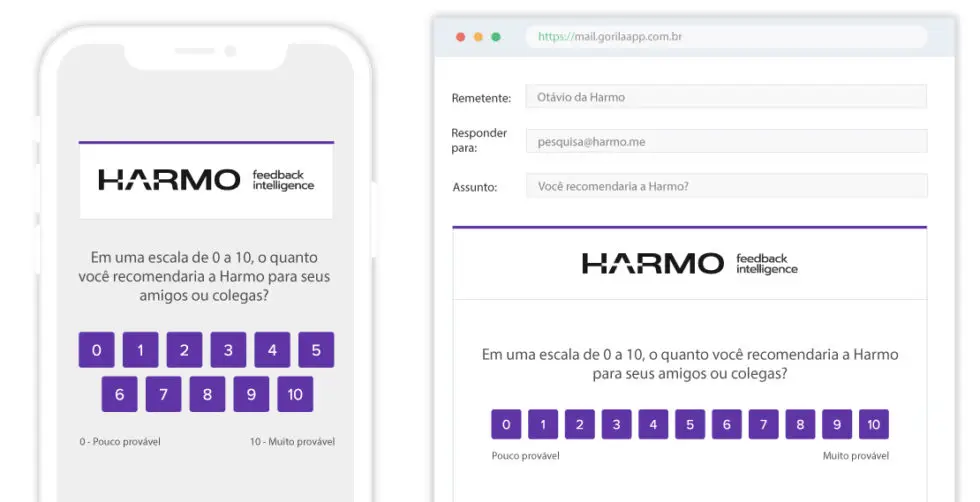
There are many benefits to asking your customers this question. You can establish better communication with your customer, and they also have the opportunity to talk about what they thought of your establishment and service. It's a way to value them and know their opinion about your brand.
And the advantages aren't just for the customers. Through this feedback, the company can better structure itself to offer a quality service, in accordance with what the customer expects.
Want to be even more subtle when asking the question? Shift the focus to what you want. For example: "What is the likelihood that you would recommend 'product x' to a friend or colleague?".
Ask employees about NPS (Net Promoter Score)
Want to know if your employees are satisfied with your company? Then you can use the NPS survey to assess this. The more satisfied your employees are, the better their performance will be in the company, and this directly impacts the satisfaction of your customers, who will then receive better service.
Also known as eNPS (Employee Net Promoter Score℠), this metric can reveal who the promoters, neutrals, and detractors of your company are. It can also help those professionals who are dissatisfied with their work environment but don't have the courage to speak up.
How likely are you to recommend this workspace to a friend or colleague?
Research is a great way to offer employees an opportunity to be heard without having to expose themselves too much, since eNPS are anonymous.
These employees, when not listened to, can become real detractors of your brand. It's also worth remembering that an employee who provides good service and another who provides poor service generate the same accounting cost on the company's payroll at the end of the month.
What are the open-ended question options for NPS?
Is it possible to modify the open-ended question used in the second stage of the NPS? Although there is a standard question, it is possible to modify it to better suit your business, as already mentioned. One of the factors to consider when crafting the question is the customer's rating.
Typically, NPS surveys have a standard open-ended question:
What is the main reason for your score?
However, we've noticed that customers are more likely to provide additional text feedback if the question relates to the score they just gave.
Several NPS services allow you to customize the open-ended question based on the score provided by the respondent. Take a look at the examples below, which you can use as alternatives to the standard question.
"What was missing from your experience with us?"
This is a great example of a question that encourages customers who haven't had a good experience with your product or service to give feedback. Constructive criticism can be highly valuable to your business in order to identify any gaps in your operations.
A case cited by Kotler in his book "Marketing Management" is that of the 3M, where he claims that more than 2/3 of its ideas for improving products and services arise from customer complaints. This shows us another important factor: Simply listening to customer feedback is not enough. Actions for improvement must be taken.
"How can we improve your experience?"
This follow-up question is ideal for neutral or detractor, as you will receive practical suggestions on what you can do to take your product or service to the next level.
You will also be able to identify exactly what you need to do to correct errors and get your product or service back on track. This way, you can prioritize problems and opportunities for improvement based on information provided by your customers.
"Which resources do you value/use the most?"
If you offer a product with multiple features, this question allows you to gather insights into which features your customers value most.
Furthermore, the data collected from this question can be of great help to product managers in determining which features should be prioritized in upcoming updates and improvements. Therefore, you can use NPS as a guiding metric to adjust the product development roadmap
What do you like most/least about (company or product name)?
This question is important for identifying customer satisfaction after interacting with your product or service. Besides being easily customizable for Promoters and Detractors, you can also ask what they liked or disliked about their experience with your business. After all, if you know what makes your customer happy or unhappy, it becomes much easier to make these adjustments, right?
With a considerable number of responses, this question can help you discover new advertising and marketing campaigns, new ways to position your product, and even transform your promoters into brand advocates. This feedback is invaluable because you can identify the main opportunities and difficulties your customer faces when using your product or service.
How to send thank-you messages?
At the end of any NPS survey , it's always recommended to thank the customer for their responses. After all, they invested some of their time to provide this valuable information to your company. Below, we've listed three thank-you messages, one for each customer category, that you can use at the end of your NPS survey:
- Promoters (9 and 10): “Thank you for your feedback. It’s great to know you’re a fan of (our company or product). Your feedback helps us discover new opportunities to improve (our company or product) and ensure you have the best possible experience.”
- Neutral (7 and 8): “Thank you for your feedback. Our goal is to create the best possible product, and your thoughts, ideas, and suggestions play an important role in helping us identify opportunities for improvement.”
- Detractors (0 to 6): “Thank you for your feedback. We greatly value all suggestions from our customers. We are always looking for ways to further improve (our product or service) so that it exceeds your expectations.”
Why is it important to personalize your search?
Listen and consistently seek feedback so that your customers feel involved in the development of your product or service. Customize your questionnaire according to your target audience and make the most of the feedback received. There is no rigid research model; they need to adapt, and a good NPS research can offer this feature to entrepreneurs.
Experiment with subject lines to stand out from the hundreds of daily emails that clog inboxes. Engage your customers in the process with compelling headlines and a personalized approach to generate detailed research data.
It's possible to create an NPS (Net Promoter Score) to conduct campaign-specific surveys, learn about email frequency, the content offered by the company, and much more. Only by testing and interpreting the collected data will you be able to gain a clear understanding of the questions that are appropriate for your company's purposes.
Conclusion
NPS surveys are essential for any company, not only externally with customers but also internally with employees.
Furthermore, it's an excellent tool for monitoring the health of your business in terms of customer satisfaction. However, you should remember that this should never be the only source of information about your customers' satisfaction.
Ultimately, your customers will use various channels to register questions, frustrations, and compliments – and it's up to you to remain active on those channels as well. Most importantly, remember that NPS will generate very objective and easily comparable data, perfect for monitoring, and therefore should be used continuously.
Receiving this feedback from customers is always a positive thing for companies. Therefore, it's necessary to understand as much as possible what happens with the customer throughout their entire journey with your company, identifying whether your product/service is delivering tangible results for the customer.
As you can imagine, this is an ongoing process – and we hope you can use NPS as one of your tools to stay engaged.
NPS is a registered trademark, and Net Promoter Score and Net Promoter System are service marks, of Bain & Company, Inc., Satmetrix Systems, Inc. and Fred Reichheld.